


For a disease that’s been studied for more than a century, Alzheimer’s still keeps one basic question stubbornly half answered: what actually kills a neuron. Toxic proteins pile up inside brain cells, that part researchers have known for decades. What happens next, the actual mechanics of a cell giving up and dying, has stayed murky. A new study out of King’s College London and the UK Dementia Research Institute just filled in a piece of that gap. The process even has a name now: karyoptosis.
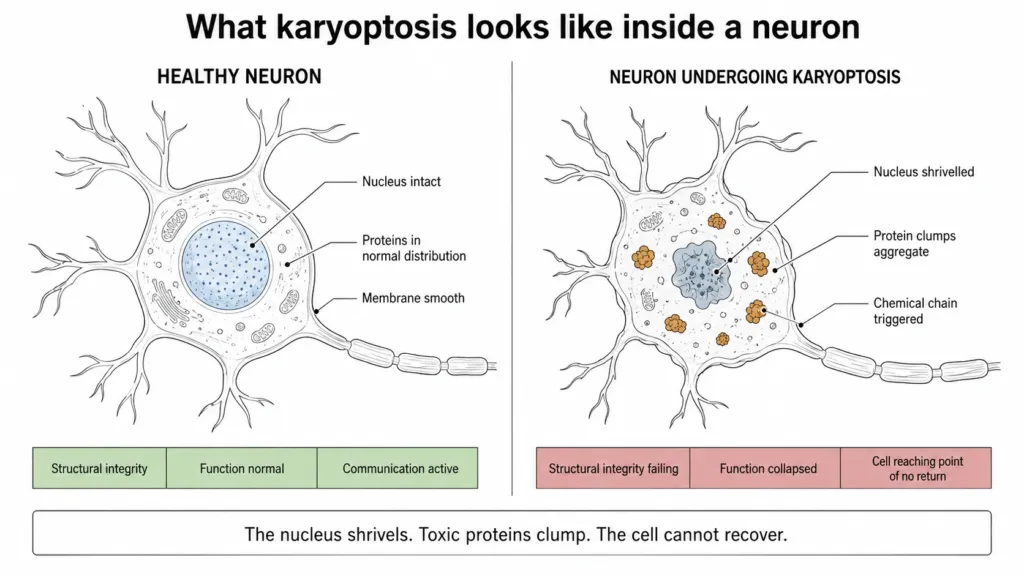
The word is new, but the process itself has apparently been hiding in plain sight, showing up in brain tissue from people who died with Alzheimer’s disease and frontotemporal dementia, two conditions that look different from the outside but seem to share this same quiet failure mode on the inside.
So what did the researchers actually do? They ran computational algorithms across more than 3,000 individual brain cells pulled from 28 patients, some with frontotemporal dementia, some with terminal-stage Alzheimer’s, then compared what they found against healthy older brains. In the frontal cortex of Alzheimer’s patients, 35% of cells showed signs of karyoptosis. In healthy older controls, that number was 15%. That gap is the whole story in one line. Something is happening in diseased brains at more than double the rate of ordinary aging.
What does karyoptosis actually look like under a microscope? A shriveled nucleus. Toxic proteins clump together inside a neuron, and that clumping seems to trigger a specific chain of chemical events the cell can’t recover from. It isn’t apoptosis, the older, better known form of programmed cell death. Apoptosis alone was never enough to explain how much neuron loss actually happens in diseases like ALS, Alzheimer’s, and frontotemporal dementia. There was always a gap between what apoptosis could account for and what was actually disappearing from the brain. Karyoptosis may be sitting inside that gap.
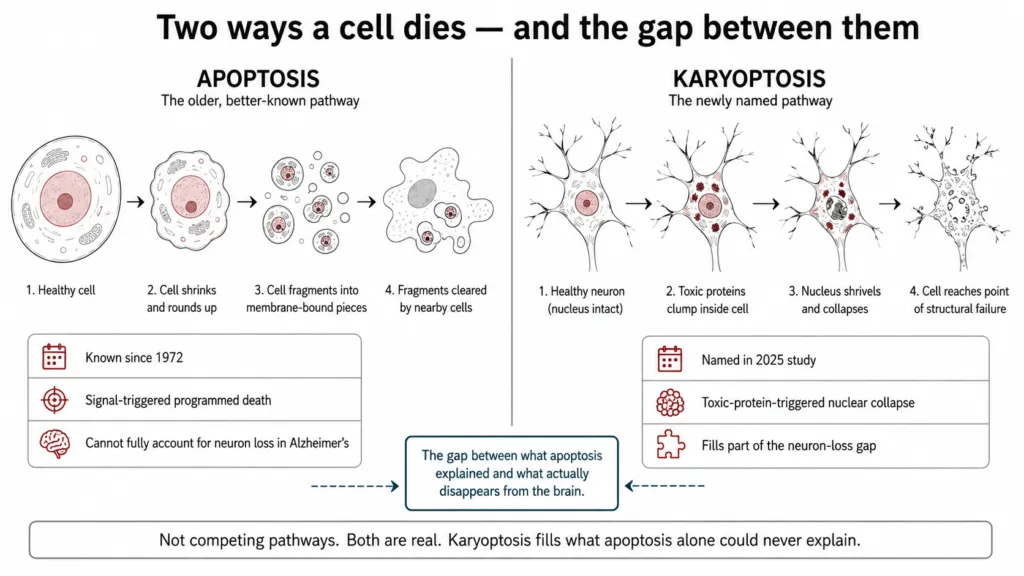
Dr. Rebecca Casterton, the study’s first author and a senior researcher at the UK Dementia Research Institute at King’s, has been chasing this mechanism for about ten years, since first spotting it in a much rarer disease long before anyone suspected it might turn up in conditions that affect millions of people. That’s the quieter part of this story. A decade of one lab following a strange, specific observation until it turned out to explain something far bigger than anyone expected at the start.
Why should a family dealing with dementia care about any of this? Because a named mechanism is something a drug can actually be built to target. The treatments on the market right now slow amyloid buildup or manage symptoms. None of them intervene at the exact moment a neuron decides it’s done. If karyoptosis really is a distinct pathway, and the early data suggests it is, it becomes a new place to aim a future treatment, one that might slow the loss of brain cells directly instead of just clearing out the debris that leads to it.
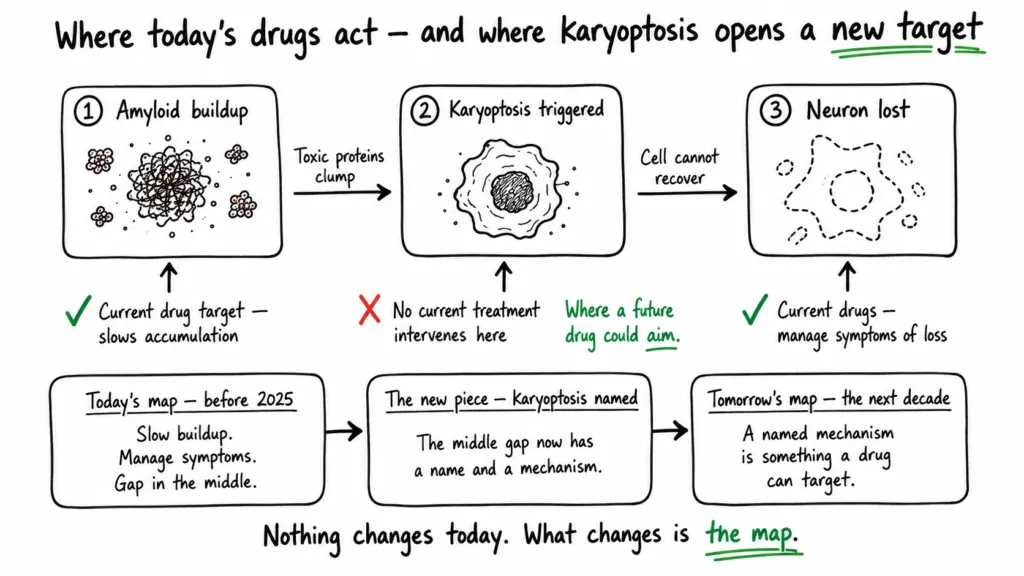
The research was published this month in Nature Communications, with funding support from Alzheimer’s Research UK. It won’t change anything about how dementia is treated today. What it changes is the map. Ten years ago, nobody had a name for this. Now they do, and that’s usually the point where the real work of turning a discovery into a treatment finally gets to start.