


If you had to guess which US profession carries the highest risk of dying from a radiation-related cancer, nuclear technologists would be a reasonable first guess. They work directly with radioactive material, after all. A new Harvard Medical School study, published in JAMA Internal Medicine, found something that upends that assumption entirely: flight attendants and pilots outrank them, placing first and second among more than 500 occupations examined, while nuclear technologists came in twelfth.
Researchers led by Anupam Jena, a professor of health care policy at Harvard, pulled death certificates for nearly 13 million people in the United States between 2020 and 2024, drawn from the National Vital Statistics System. That dataset included roughly 14,000 pilots and 7,000 flight attendants, enough to measure something earlier, smaller studies could only gesture toward. Lung cancer was deliberately excluded from the analysis to keep smoking from muddying the results, since smoking rates differ across professions for reasons that have nothing to do with the job itself.
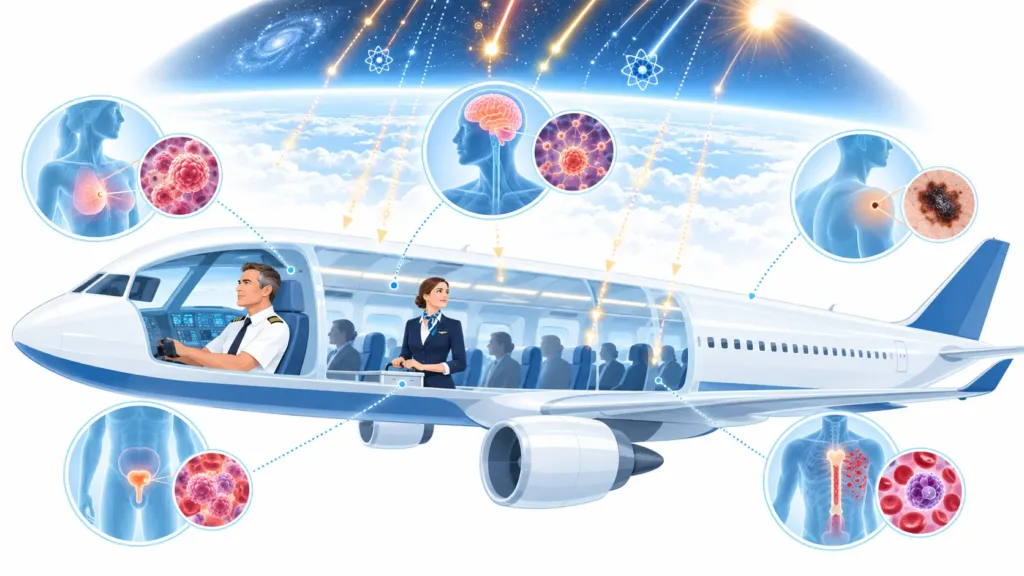
What remained was striking. Radiation-related cancers accounted for 6.9% of all deaths among flight attendants and 6.7% among pilots, translating to roughly 50% higher odds of dying from one of these cancers for flight attendants, and about 36% higher odds for pilots, compared with the general working population. Breast cancer, central nervous system cancer, prostate cancer, and melanoma all showed statistically significant elevation in both groups. Pilots specifically carried a higher rate of leukemia deaths on top of that.
The researchers didn’t stop at flight crew. They also checked aircraft mechanics and assemblers, people who work in and around the same industry but spend their careers on the ground. That comparison group showed no elevated risk at all, which does real work ruling out some generic aviation-industry explanation, chemical exposure in hangars, irregular schedules, or anything else tied to the broader field rather than to time spent at altitude specifically.
The likely culprit is cosmic radiation, the kind of background radiation that increases with altitude and that commercial flight crews absorb at an estimated 3 to 6 millisieverts a year, accumulating with every year spent in the job. Jena has pointed out plainly that the risk will accumulate the more time a pilot or flight attendant is employed, which frames this less as a sudden danger and more as a slow, career-length exposure finally showing up in the mortality data decades of smaller studies weren’t large enough to catch clearly.
There’s a genuinely useful correction buried in this research too, one that reframes a belief a lot of people have carried for years. A commentary accompanying the study, written by Harvard’s Vishal Patel, directly challenged the common assumption that flight crews’ elevated skin cancer rates come from repeated layovers in sunny vacation destinations, poolside hours in Miami or Cancun between shifts. The data points somewhere else entirely: toward cosmic radiation exposure in the cockpit and cabin itself, not the beach.

None of this means commercial flying is suddenly a hazard for passengers, who spend a vanishing fraction of the time in the air that a career flight crew member does. What the findings do support, according to the researchers, is a real conversation about occupational radiation protections for the people who make flying possible, the same kind of workplace safety standard already applied to other professions with measurable radiation exposure, just not, until now, with data this clear showing aviation belonged on that list at all.
For a family with a parent or relative who spent a career in the cockpit or the cabin, this research offers something worth bringing up at a doctor’s visit directly, particularly given that prostate cancer, one of the cancers elevated in this study, is also the focus of newer, more targeted treatment approaches already showing real progress against its more aggressive forms. A long career spent at altitude is a specific, measurable risk factor worth naming on a medical history, not a vague occupational footnote.