

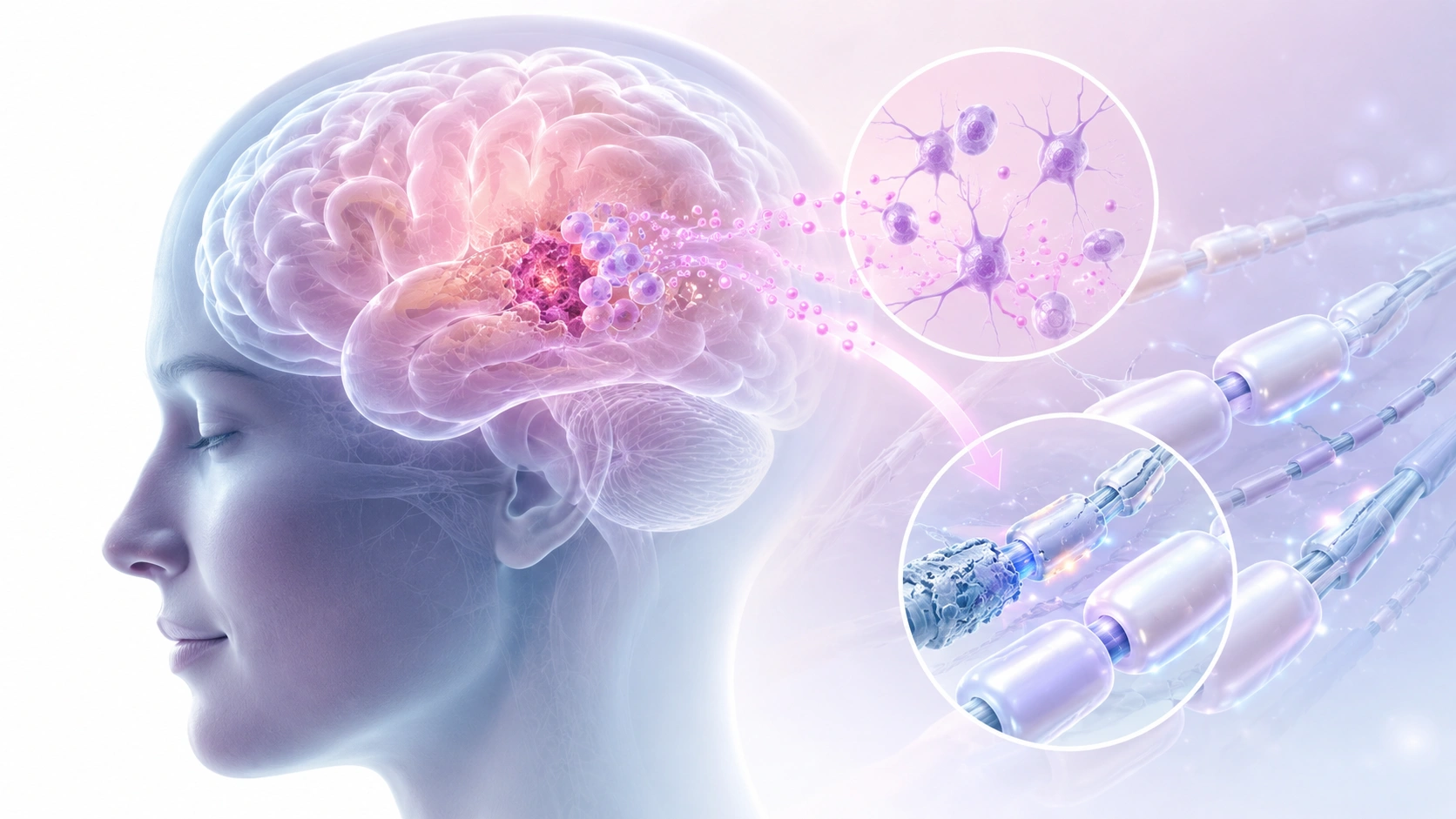
A master’s student at the Max Planck Institute of Psychiatry kept noticing the same mysterious cells clustering at the edges of brain injuries in mice, and nobody could tell him what they actually were. That small, unresolved puzzle turned into a doctoral thesis, and the doctoral thesis just turned into a genuinely surprising discovery, published in Cell Reports by research group leader Jan Deussing’s lab: the same hormone best known for driving the body’s stress response also appears to help the brain repair itself after damage.
The mystery cells turned out to be oligodendrocyte progenitor cells, OPCs for short, the Max Planck Institute’s own account explained, the precursor cells responsible for eventually maturing into oligodendrocytes, which build myelin, the fatty insulation wrapped around nerve fibers that keeps electrical signals moving properly. When myelin gets damaged, whether from injury or disease, restoring it depends on OPCs multiplying and maturing at the right pace. Too fast, and something goes wrong.
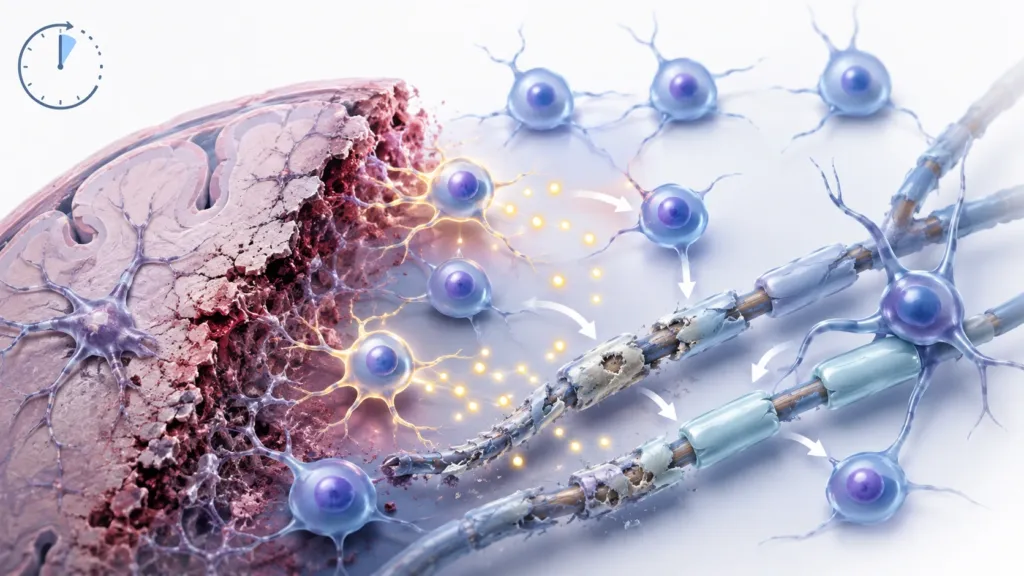
What the researchers found is that roughly a third of all OPCs near an injury site rapidly begin producing corticotropin-releasing hormone, CRH, a neuropeptide central to the body’s classic stress cascade, the same signal behind the fight-or-flight response. Nobody had known OPCs could make neuropeptides like this at all, Technology Networks noted in its own coverage of the mechanism. Production starts within hours of an injury and shuts off again after about three days, a narrow, tightly timed window rather than an ongoing signal.
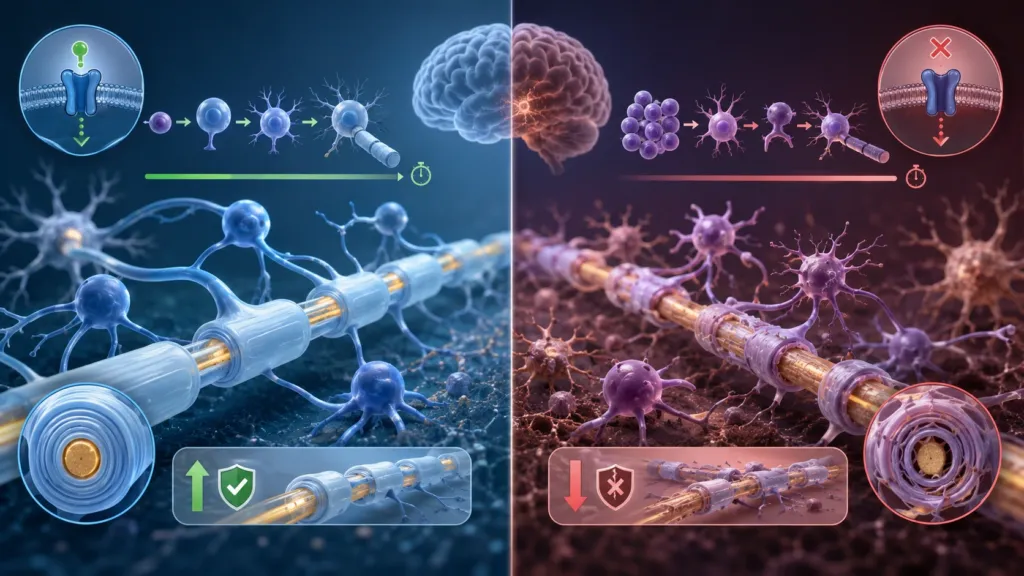
That timing turns out to be the whole point. CRH appears to act as a kind of pacing mechanism, preventing OPCs from maturing prematurely before repair conditions are actually ready. A receptor called CRH receptor 1 carries out that effect on a separate population of OPCs. Remove the receptor, and OPCs multiply faster after an injury, which sounds like it should help, except it doesn’t. Fewer of those cells go on to become lasting, functional oligodendrocytes. Speed without proper timing produces a rushed, less durable repair, not a better one.
The story doesn’t stop at injury. The same receptor shows up on OPCs even without any damage present, which sent the researchers looking at whether CRH plays a role in ordinary brain development too. It does. In young mice lacking the receptor, more OPCs formed early on, with effects that lasted into adulthood, showing up as changes in myelin thickness, particularly around thinner nerve fibers. During normal development, the CRH signal appears to come from neurons themselves rather than from OPCs, a different source cell doing a related job depending on whether the brain is growing or healing.
That dual role, present during both development and repair, is what makes CRH interesting well beyond this one study. It’s a hormone deeply tied to how the body responds to stress and, by extension, to conditions like anxiety and depression where that stress system runs poorly calibrated, a connection covered internationally as researchers weigh what it could mean for psychiatric conditions specifically. Finding it doing quiet, local, protective work at an injury site complicates the usual story where stress hormones are treated as something the brain needs protecting from, not something the brain is actively using to heal itself, reporting that reached readers well beyond the neuroscience field itself. Researchers see real potential here for two separate lines of investigation: a better understanding of stress-linked psychiatric conditions, and a genuinely new angle on demyelinating diseases like multiple sclerosis, where restoring damaged myelin properly, not just quickly, is exactly the outcome doctors are trying to achieve, a goal that sits alongside other recent work on brain cell survival after damage, even in an entirely different disease context.
None of this is close to a treatment yet. The work is confined to mice, and the receptor’s role in something as complex as human depression or MS will take considerably more research to pin down. What it offers for now is a genuinely new thread connecting the brain’s stress-response chemistry to its capacity for physical repair, discovered because one student couldn’t walk past an unexplained cell cluster without wanting to know what it was doing there.