
A newly discovered protein called HELZ2 can dial down the number of LDL particles the liver releases into the blood, and it works before the cholesterol particle is even built.
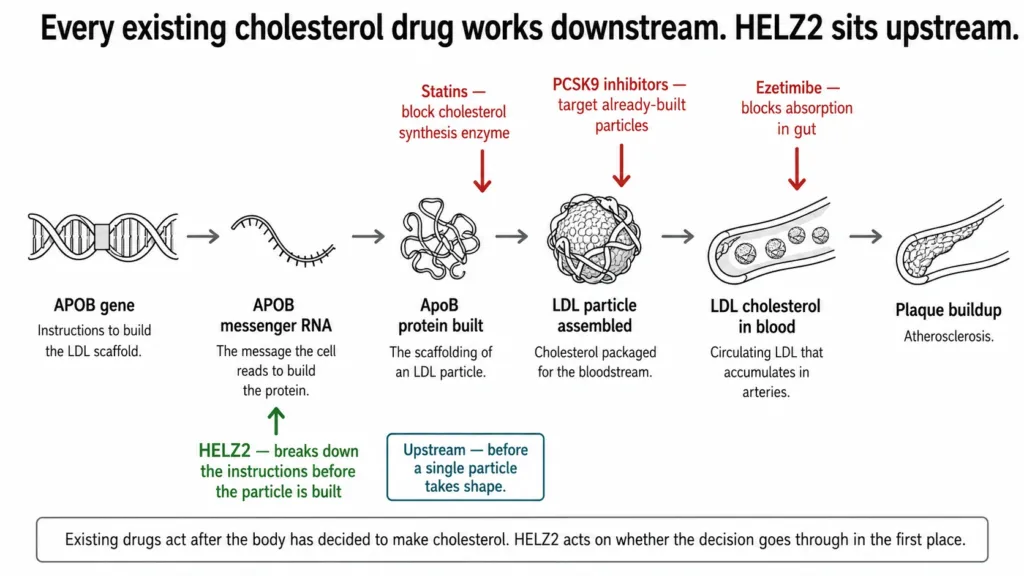
For decades, nearly every cholesterol drug on the market has worked the same basic way. Block an enzyme somewhere in the chain that builds cholesterol, after the body has already decided to make it. Statins do this. So does ezetimibe. So do the newer PCSK9 inhibitors. A team at UT Southwestern Medical Center just found something that works earlier in the process, at the genetic instruction level, before a single cholesterol particle takes shape.
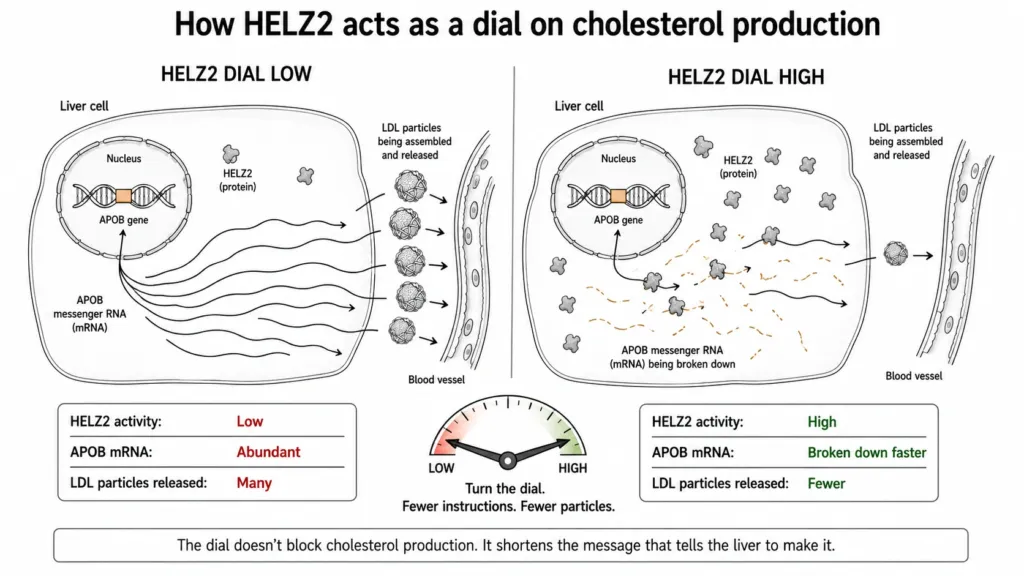
The protein is called HELZ2. Researchers, led by senior author Zhao Zhang, found that it controls a gene called APOB, the gene responsible for building apolipoprotein B, the core scaffolding of LDL particles and their more dangerous cousins. Turn HELZ2 activity up, and the messenger RNA carrying the instructions for apoB breaks down faster. Fewer instructions, fewer particles, less LDL cholesterol reaching the bloodstream.
So what does that actually mean for a person’s arteries? Mice bred with extra HELZ2 activity produced fewer LDL particles and showed less plaque buildup in the aortic root, the classic marker of atherosclerosis, the disease process behind most heart attacks and strokes. Zhang described HELZ2 as “a kind of dial between the liver and the bloodstream.”
The Catch: More Liver Fat for Less Blood Cholesterol
Turning the HELZ2 dial up lowered cholesterol in the blood, but it raised fat buildup in the liver at the same time. Nothing here is free. The mice traded one problem for a smaller version of a different one, and that tradeoff is exactly the kind of detail that tends to get lost by the time a discovery like this reaches a headline.
The study, published in Circulation, the American Heart Association’s own journal, came out of a genetic screening system built by Nobel laureate Bruce Beutler at UT Southwestern’s Center for the Genetics of Host Defense. It was funded through the National Institute of Diabetes and Digestive and Kidney Diseases.
None of this is a drug yet. It’s a mechanism, a target, a dial nobody knew existed until now. Getting from a mouse liver to a pill a cardiologist can actually prescribe typically takes years, sometimes a decade or more, and plenty of promising mouse mechanisms never make that trip at all. That gap between finding a switch and building a drug is where most cholesterol research quietly goes to die.
For now, what the UT Southwestern team has is a genuinely new place to look. Statins, ezetimibe, and PCSK9 inhibitors all worked on the tail end of the same pathway. HELZ2 sits further upstream, closer to the source. Whether that turns into anything a person can actually take remains an open question, and the researchers themselves are careful not to answer it before the science is ready to.