
Most claims about brain training don’t survive contact with rigorous evidence. Puzzle apps promise sharper thinking and mostly deliver better puzzle-solving, nothing more. So when a finding actually holds up under the toughest test science has, a randomized controlled trial with two full decades of follow-up, it deserves real attention rather than the usual skepticism. That’s exactly what researchers at Johns Hopkins Medicine just delivered.
The Trial Built to Actually Answer This
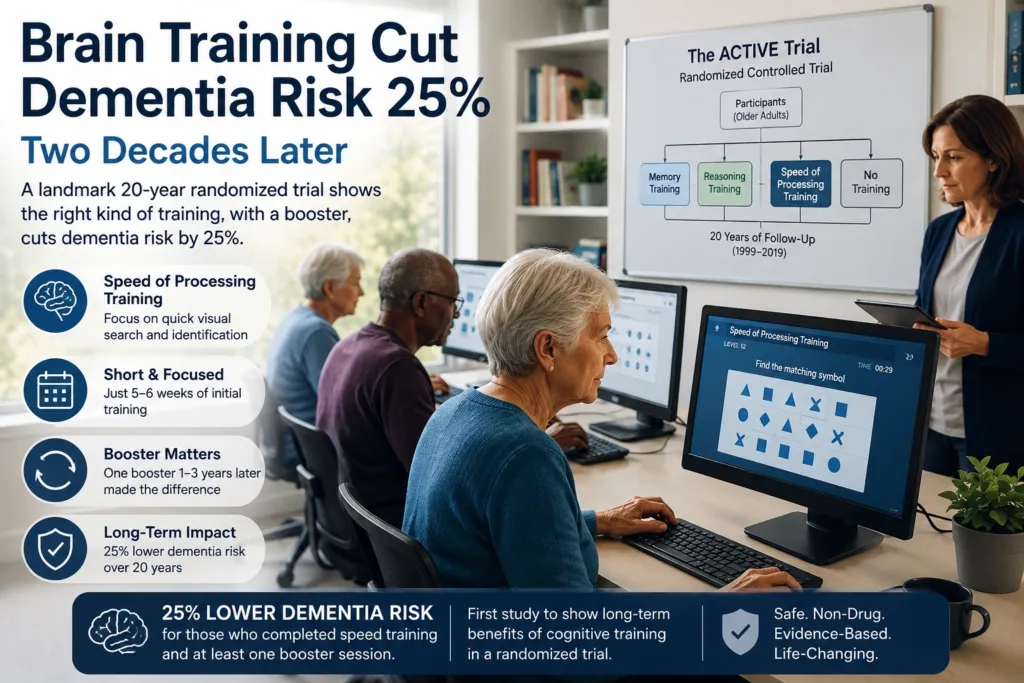
The findings come from the ACTIVE study, short for Advanced Cognitive Training for Independent and Vital Elderly, the largest randomized trial in the United States to compare different types of cognitive training in older adults. Participants were randomly assigned to one of four groups: memory training, reasoning training, speed of processing training, or no training at all. Researchers then linked the original trial data to two decades of Medicare claims, from 1999 through 2019, to see which kind of training, if any, actually reduced real-world dementia diagnoses over the following 20 years. As Johns Hopkins’ Hub reported, this is the first and only study of its kind to track a cognitive training trial this far out.
Twenty-Five Percent, But Only With a Booster
Here’s the headline result. Participants who received speed of processing training, and who also completed at least one booster session roughly one to three years after the initial training, had a 25% lower risk of being diagnosed with dementia over the following two decades. In the language researchers use, the hazard ratio was 0.75, meaning a quarter less risk compared with the untrained control group.
The catch, and it’s an important one, is that the booster session wasn’t optional in practice. Participants who completed the initial speed training but skipped the follow-up booster sessions showed no reduction in dementia risk at all. The initial training mattered. It just didn’t stick without reinforcement. Memory training and reasoning training, the other two active arms of the trial, showed no significant effect on 20-year dementia risk either way, documented alongside the full 20-year dataset.
What Speed Training Actually Involves
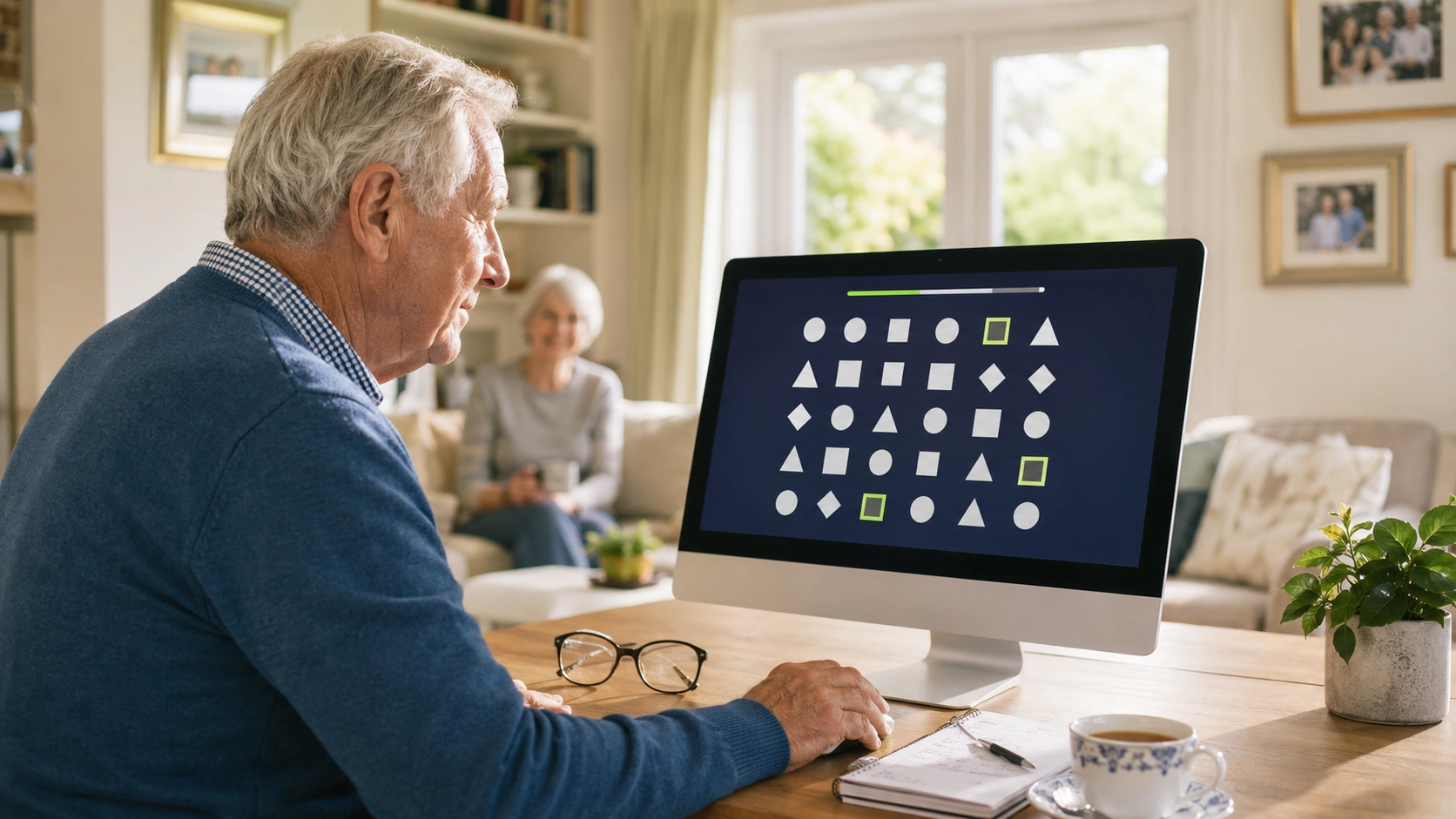
Speed of processing training isn’t a vague concept. In the ACTIVE trial, it meant structured computer exercises built around finding and identifying visual information quickly, then managing increasingly complex versions of that same task under time pressure. It’s a specific, trainable skill, less about memorizing facts and more about how fast the brain can take in and act on visual information in real time.
The dose involved was genuinely modest. Just five to six weeks of initial training, followed by occasional booster sessions years later, produced a measurable effect two decades on. Marilyn Albert, the study’s corresponding author and director of the Alzheimer’s Disease Research Center at Johns Hopkins, called the finding remarkable precisely because it points to a fairly modest nonpharmacological intervention having genuinely long-term effects. That’s a meaningful thing to say about a treatment with no side effects, no prescription, and no ongoing cost beyond a handful of training sessions.
Why the Reasoning and Memory Arms Came Up Empty

It’s worth sitting with the negative results here too, since they’re just as informative as the positive one. Neither memory training nor reasoning training showed the same long-term association with lower dementia risk, flagged by researchers directly as a genuine open question rather than a footnote to explain away. Albert and her colleagues have said plainly that more research is needed to understand why processing speed training produced this effect while the other two didn’t. One plausible explanation is that speed of processing draws on a more fundamental, foundational cognitive skill, the kind that supports a wide range of daily tasks, from driving to managing medications, in a way that a narrower reasoning or memory exercise might not.
What This Means for Someone Deciding Where to Put Their Effort
For anyone weighing how to actually spend limited time and energy on brain health, this study narrows things in a genuinely useful way. Not every brain training program is created equal, and this study offers real evidence for one specific approach over the general category. That distinction matters for a family trying to help an aging parent make good use of their time, and it fits neatly alongside the broader case for prevention that’s been building across dementia research this year.
None of this replaces the other pillars of brain health, physical activity, sleep, nutrition, and social connection all still matter enormously, the same way a modest four-week change was enough to shift measurable aging markers in a completely different study. What this trial adds is something rarer than another general wellness recommendation: a specific, tested, time-limited intervention with real evidence behind it, two decades of it, that a person could actually start using this week.