

Back in May, a University of Sydney study made a quiet but genuinely striking claim: a diet change lasting just four weeks could measurably lower an older adult’s “biological age.” It’s now been about two months since that study published, long enough for the initial wave of headlines to fade and long enough to ask the more useful question. Does it actually hold up once the excitement dies down? Based on what the researchers themselves said at the time, and what nothing since has contradicted, the answer looks like a cautious yes.
What Actually Changed in Four Weeks
The study, published in the journal Aging Cell and led by Dr. Caitlin Andrews at the University of Sydney’s Charles Perkins Centre, followed 104 adults between the ages of 65 and 75. All were non-smokers, all ate meat, and none had serious health conditions like diabetes, cancer, or liver disease going in. Every meal was prepared and delivered to participants directly, so nobody was left guessing about portions or ingredients.
Each person was randomly assigned to one of four diets for four weeks. All four provided the same 14% of energy from protein, but they varied in two ways: where that protein came from, and whether the rest of the plate leaned toward fat or carbohydrates.
- Omnivorous, high-fat (OHF): closest to what most participants were already eating day to day
- Omnivorous, high-carbohydrate (OHC): same animal-and-plant protein mix, but 28 to 29% fat and 53% carbohydrates
- Semi-vegetarian, high-fat (VHF): 70% of protein from plant sources, higher fat
- Semi-vegetarian, high-carbohydrate (VHC): 70% plant protein, higher carbohydrate
To track what these diets actually did inside the body, researchers measured 20 separate biomarkers, cholesterol, insulin, C-reactive protein, and more, and combined them into a single biological age score for each participant.
The Diet That Won, and the One That Went Nowhere
Here’s the part worth sitting with. Three of the four groups showed a real reduction in biological age after just four weeks. Only one group didn’t move at all, and it happens to be the one that most closely resembled how people were already eating before the study started, the high-fat, animal-protein diet. Familiar eating patterns produced familiar results. Nothing changed because nothing really changed.
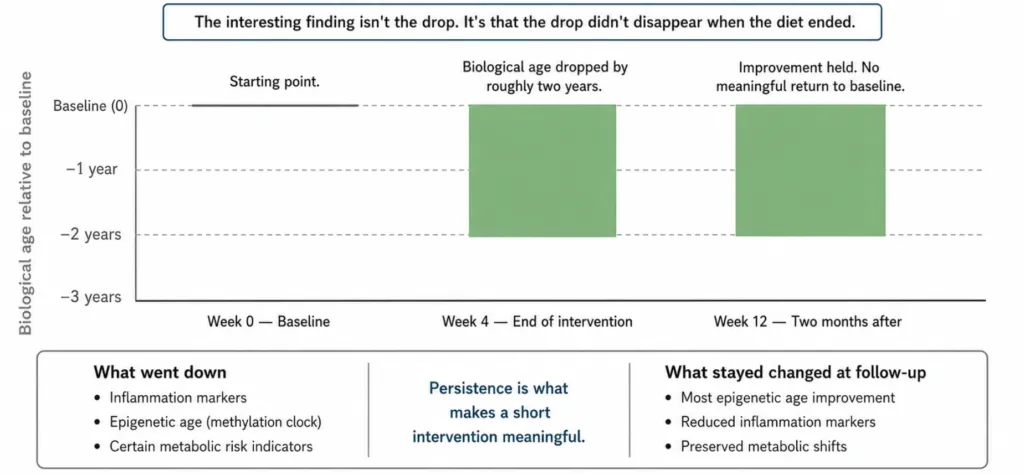
The strongest, most statistically confident result came from the omnivorous high-carbohydrate group, the diet built around 53% carbohydrates and only 14% protein, without requiring anyone to give up meat entirely. That’s worth pausing on, because it means the biggest benefit didn’t require becoming vegetarian. It required shifting the balance of what was already on the plate.
So does that mean cutting meat matters less than people assume? Not exactly. The two semi-vegetarian groups also showed real reductions in biological age, just with slightly less statistical certainty behind the numbers. What the data suggests is that there may be more than one route to the same destination, lower fat, more plant protein, or some blend of both, and the worst outcome came specifically from staying put.
Why Cholesterol, Insulin, and Blood Pressure Are the Real Story Here
Biological age isn’t a mystical number. It’s built from measurements doctors already check at a routine physical, cholesterol, insulin sensitivity, inflammation, and blood pressure among them. These happen to be the same handful of markers that show up again and again in conversations about heart disease and stroke risk in older adults.
That overlap is exactly why this study matters beyond a headline about looking younger. A drop in biological age here isn’t a cosmetic number. It’s a proxy for the same cardiovascular and metabolic risk factors that quietly shape how well someone ages, how long they stay independent, and how many of the conditions that complicate elder care actually show up in the first place.
What the Researchers Themselves Are Not Claiming
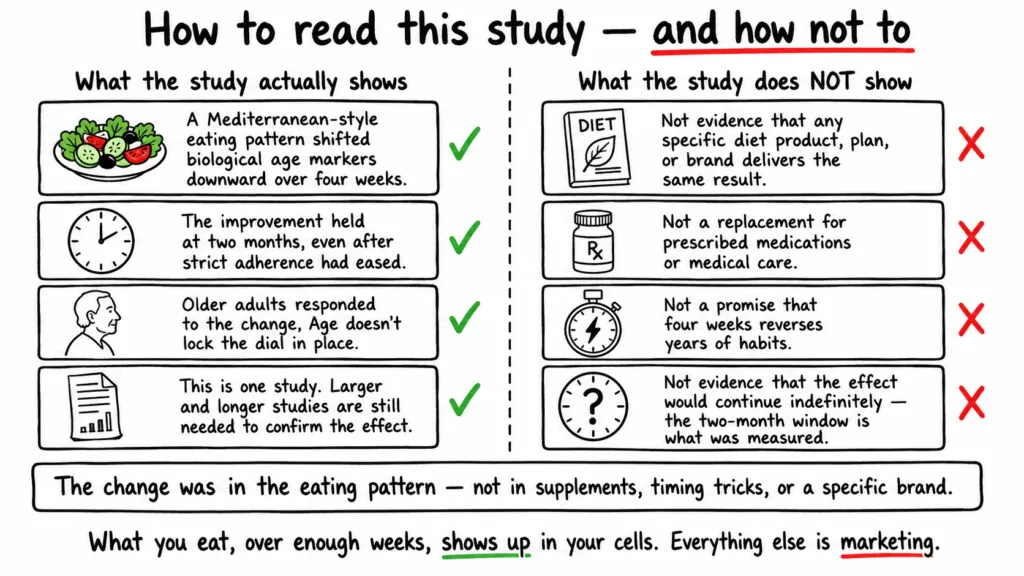
This is the part that tends to get dropped by the time a study becomes a headline, and it’s worth restoring here specifically because two months have passed and nothing has walked it back. The study’s supervising author, Associate Professor Alistair Senior, was careful to note that longer trials are still needed before anyone can say whether these short-term biomarker shifts actually translate into a lower risk of age-related disease down the road. Four weeks shows what the body can do quickly. It doesn’t yet show what holds up over years.
A few other limits are worth naming plainly. The group was relatively small, just over a hundred people. Everyone was already a meat-eater at the start, so the findings say less about people who’ve been vegetarian for decades. And every meal was prepared and delivered for participants, which is a much more controlled situation than anyone actually managing a household’s groceries and cooking.
None of that erases the finding. It just means the honest version of this story is “a real, measurable, four-week effect with real limits,” not “diet reverses aging,” and that honest version has aged fairly well over the last two months, since nothing published since has contradicted it.
What This Actually Looks Like on a Plate
For a family managing meals for an older parent, the practical version of this research isn’t complicated. It points toward a plate with more whole grains, legumes, vegetables, and fruit, less saturated fat from red meat and full-fat dairy, and protein that doesn’t all have to come from animal sources to see a benefit. Nobody needs to overhaul everything overnight or force a parent into an unfamiliar vegetarian diet against their preference. The biggest win in this study came from adjusting the balance of an existing omnivorous diet, not from abandoning it.
The takeaway that’s actually held up two months later is a modest one, and modest is not the same as unimportant. A month of eating differently moved real, measurable markers of aging in a group of people well past the age when most people assume it’s too late for diet to matter much at all.