

If a parent or spouse has had what doctors call a lacunar stroke, the treatment plan probably looked familiar. An aspirin, maybe a statin, the standard playbook built around clearing blocked arteries. New research out of the University of Edinburgh suggests that playbook may be aimed at the wrong target entirely, at least for this particular kind of stroke.
Lacunar strokes are small, deep, and easy to miss on a first scan. They happen when tiny blood vessels buried far inside the brain get damaged, not the large arteries most stroke coverage focuses on. On its own, one of these strokes might barely register, just a small patch of dead tissue tucked somewhere in the brain’s interior. But they tend to recur, and over years they can pile up into something much harder to ignore: memory loss, trouble walking, a slow drift toward dementia.
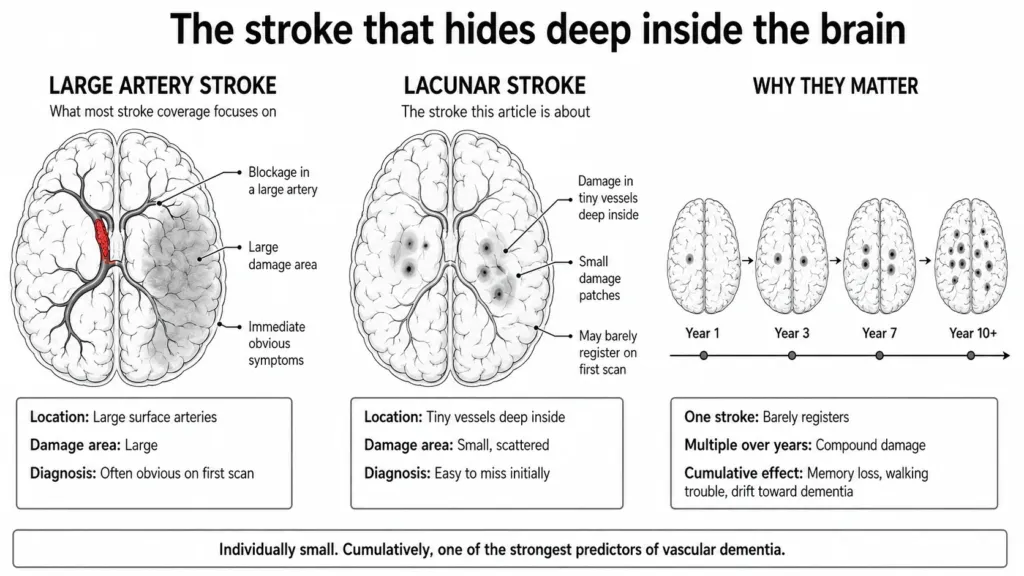
For decades, doctors assumed the underlying cause matched most other strokes, fatty plaque narrowing the arteries until blood flow gets choked off. Professor Joanna Wardlaw, who led the new study published in the journal Circulation, went looking for that plaque and found something else instead. The strongest link to lacunar stroke wasn’t narrowing at all. It was widening, elongation, and twisting of a specific artery deep in the brain’s posterior circulation. The more warped that artery appeared on imaging, the more small vessel disease turned up elsewhere in the brain, and the more new damage kept showing up on follow-up scans months later.
Wardlaw’s team found no meaningful link between plaque buildup and this kind of stroke at all. The real disease, by her account, is happening inside the small vessels themselves, not in the large arteries doctors have spent decades treating.
So why should that matter to a family managing a parent’s recovery right now?
Because it explains something doctors have quietly struggled with for years, why the standard stroke prevention toolkit, the aspirin, the cholesterol drugs, the whole approach built around clearing blockages, so often fails to stop a second lacunar stroke from happening. Wardlaw has said plainly that the absence of any real connection between plaque and this type of stroke helps explain why current prevention guidelines underperform here, and why they do little to slow the cognitive decline that tends to follow. That’s not a small admission from someone who has spent a career studying this disease. It suggests a meaningful share of stroke survivors, roughly one in four by some estimates, have effectively been treated for the wrong mechanism the entire time.
Here’s the part worth sitting with for a moment. This isn’t just a discouraging finding sitting quietly in a medical journal. It’s already reshaping what gets tested next. A trial called LACI-3 is currently underway, looking at whether two existing medications, cilostazol and isosorbide mononitrate, can protect these small vessels directly instead of chasing plaque that may never have been the real problem to begin with. If the trial pans out, the payoff wouldn’t just be fewer repeat strokes. It could mean real protection for memory, mobility, and independence, exactly the things a home care agency spends every day trying to preserve.
None of this means changing a parent’s current medications based on one study, and no responsible doctor would suggest that either. What it does change is the conversation worth having at the next neurology visit, and the question worth asking out loud: is this treatment actually aimed at what’s damaged, or at what doctors have simply assumed was damaged for the last several decades?