

Alzheimer’s disease has spent the better part of three decades organized around a single villain: amyloid-beta, the sticky protein that clumps into plaques between neurons. Billions of research dollars followed that villain. So did most of the drugs that eventually reached patients. Tau, the other protein central to the disease, the one that tangles up inside neurons rather than outside them, has always played something closer to a supporting role in the public imagination, even though plenty of researchers would argue it tracks more closely with actual cognitive decline than amyloid ever did. A new study out of Sanford Burnham Prebys, published in Science Advances, finally gives tau its own protective hero, and it turns out to be a molecule that was already famous for fighting the other side of the disease.
A Protein With a Head Start
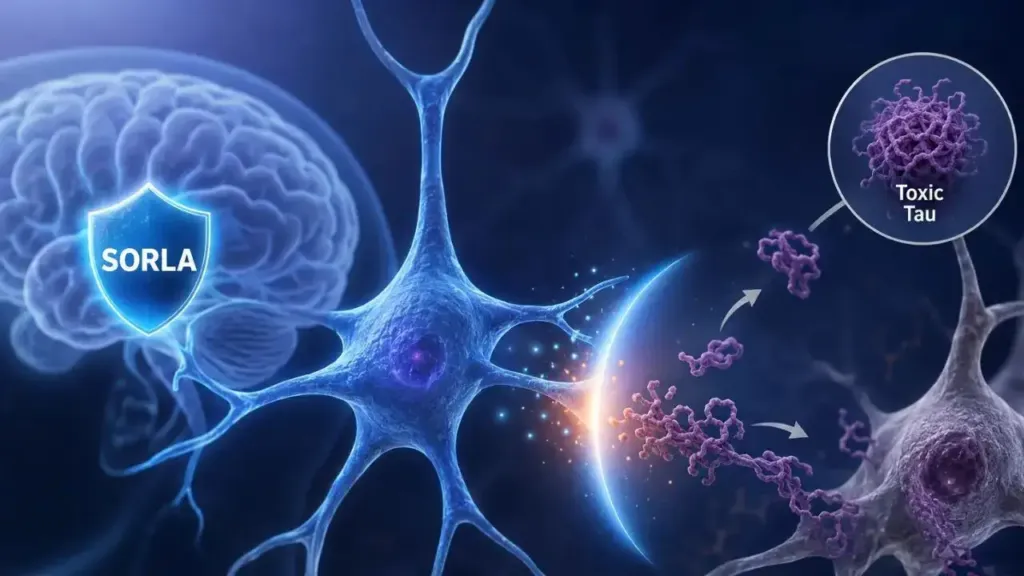
The molecule is called SORLA, shorthand for sorting-related receptor with A-type repeats, and researchers led by Timothy Huang at Sanford Burnham Prebys have been studying it for years. For roughly the last fifteen to twenty years, data from Huang’s lab and others has established that SORLA suppresses amyloid-beta generation and accumulation, one of Alzheimer’s two defining pathologies. What nobody had tested carefully, ScienceDaily’s coverage noted, was whether the same protein did anything at all on the tau side of the disease, the tangles rather than the plaques.
Building a Mouse That Could Answer the Question
To find out, the team crossbred two lines of mice. One produced extra human SORLA protein. The other, a well-established tauopathy model known as PS19, develops tau tangles, brain atrophy, and cognitive deficits as it ages, mimicking the tau side of human Alzheimer’s disease fairly faithfully. Breeding the two together created mice carrying both the disease process and an oversupply of the protective protein, letting researchers watch what happened when SORLA had tau tangles to actually work against.
What More SORLA Actually Did
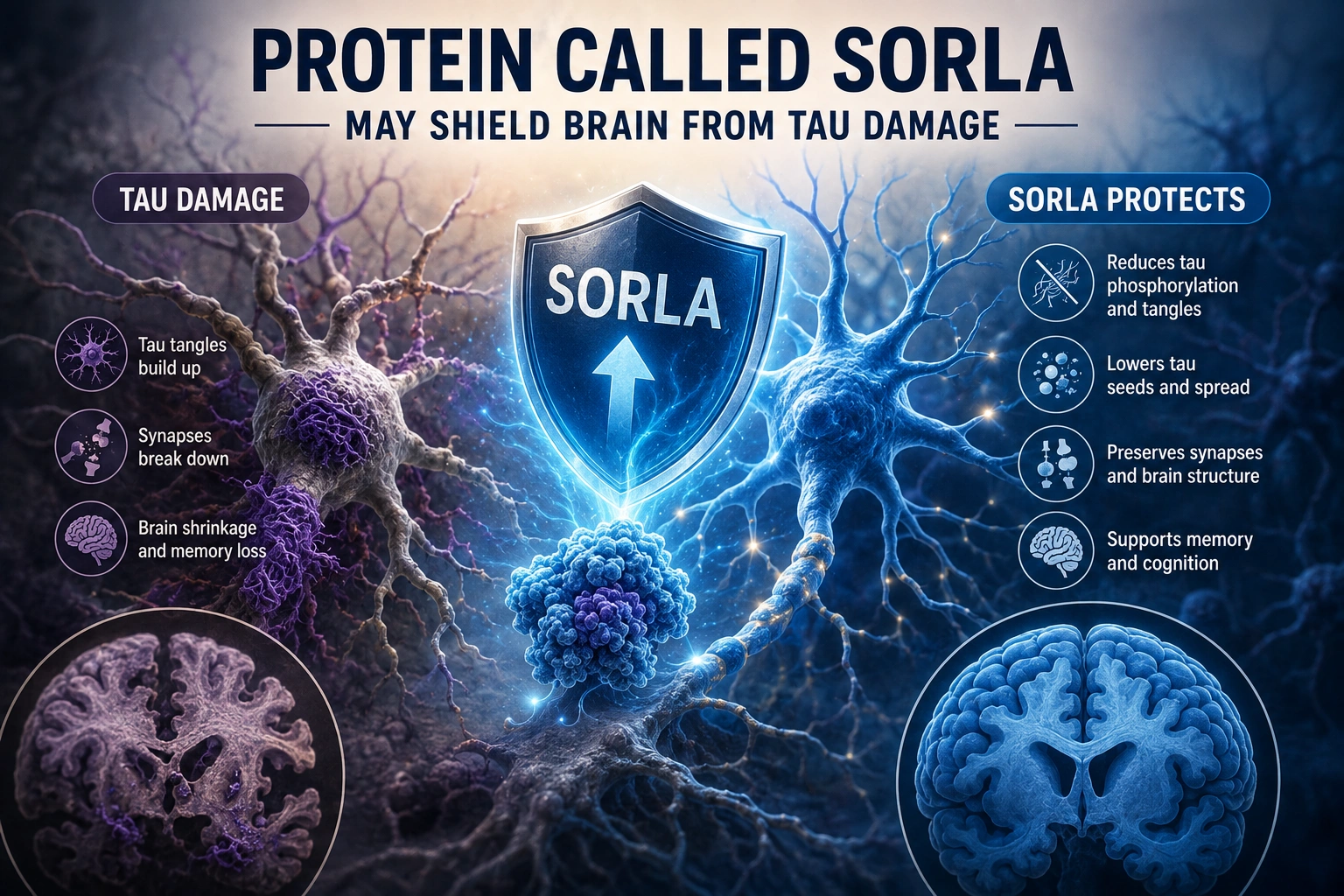
The results were consistent across several separate measures. Mice with elevated SORLA showed less tau hyperphosphorylation, the excessive chemical tagging that pushes tau toward clumping in the first place, along with fewer tau “seeds,” the small starting clusters that recruit more tau protein and let tangles spread. Brain atrophy was reduced. Synaptic connections, the actual wiring between neurons that memory depends on, held up better. And Medical Xpress reported that mice engineered to lack the SORL1 gene, the gene that makes SORLA, showed the opposite pattern: measurably worse tau damage than normal. The relationship ran in both directions, which is exactly the kind of consistency that turns a promising correlation into a credible protective mechanism.
Lead author Huijie Huang summed up the core finding plainly: when you upregulate SORLA, you can suppress the negative effects found in tauopathies. That’s a fairly restrained way of describing a protein that touched multiple separate steps in the tau disease process at once, rather than blocking just one narrow point along the way.
Why a Dual-Action Protein Actually Matters
Here’s what makes this finding worth more attention than a typical single-mechanism mouse study. Most Alzheimer’s drug candidates that have reached patients target one pathology or the other, amyloid or tau, rarely both. That’s partly a legacy of how the field organized itself for so long around amyloid specifically, with tau research generally treated as the secondary concern. A protein that already suppresses amyloid buildup and now appears to independently protect against tau tangles, Newsweek reported, is a genuinely rare candidate for addressing both sides of the disease through a single therapeutic target, rather than requiring two separate drugs aimed at two separate mechanisms.

That dual action doesn’t just simplify future drug development in theory. It reflects something real about how these two pathologies likely interact inside an actual diseased brain, where amyloid and tau don’t operate in isolated tracks so much as compound each other’s damage over time.
What Happens Next
None of this puts a SORLA-boosting treatment anywhere close to a pharmacy shelf. This is preclinical work in genetically engineered mice, and the honest next steps, GEN’s coverage detailed, involve understanding exactly how SORLA accomplishes this protection at a mechanistic level, and whether that protection can be safely and effectively boosted with a drug in a human brain. Huang’s team has also floated a potentially faster route: screening existing, already-approved medications for the ability to raise SORLA activity, rather than starting the yearslong process of building an entirely new compound from scratch.
Alzheimer’s disease affects more than 6 million Americans today, and tau tangles track closely with the cognitive decline patients and families actually experience. A protein already known for fighting one hallmark of the disease turning out to fight the other as well isn’t a cure. It’s the kind of finding that reshuffles which targets look worth chasing next, a pattern already underway across several fronts of Alzheimer’s research this year, from how toxic tau actually spreads between neurons to what redirects it toward safer, more productive work inside the cell in the first place.