
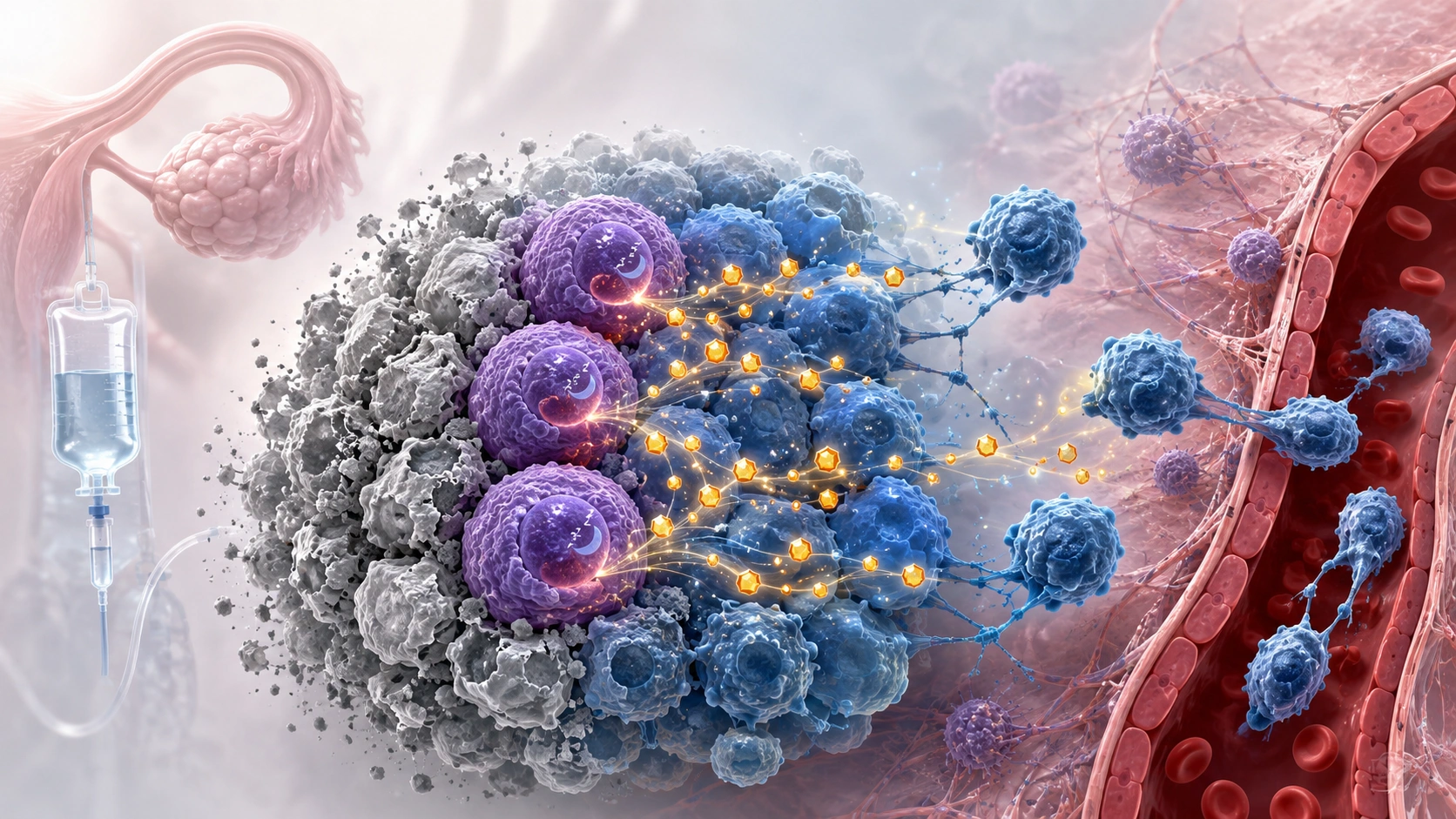
Most cancer research divides tumor cells into two camps after chemotherapy: the ones that died, and the ones that kept dividing and drove a relapse. Researchers at The Wistar Institute went looking at a third group that usually gets ignored, cells that survived treatment but stopped dividing entirely, sitting quietly in the tumor without growing. Conventional wisdom treated these dormant cells as basically harmless, spent, no longer a threat. A new study, published in Nature Aging, says that assumption was wrong.
The Hidden Activity of Dormant Cancer Cells
Nearly every ovarian cancer patient receives platinum-based chemotherapy, and the drugs usually work well at first, shrinking tumors and sending the disease into apparent remission. The disease comes back in most patients anyway, and when it does, metastasis accounts for roughly 90% of the deaths that follow. First author Aidan Cole, a postdoctoral fellow in Katherine Aird’s lab, wanted to know what these survivor cells were doing while they sat there not dividing.
The answer: quite a lot. Some cancer cells that survive chemotherapy aren’t dividing anymore, but they’re still biologically active, Cole explained. Instead of growing, these cells keep releasing molecules into their surroundings, chemical messages aimed at the healthy-looking tumor cells still nearby. One of those messages turned out to be an ordinary sugar. Fructose, released by the dormant survivors, weakens the physical attachments holding neighboring tumor cells together, loosening them enough to break free and spread to new locations in the body. The cells that looked defeated were actually recruiting.
A Detail About Diet and a Common Medication That’s Still Unsettled
Buried further in the research is a thread the team says needs a lot more work before anyone draws firm conclusions from it. In the same preclinical models, high dietary fructose and cholesterol-lowering medications both produced related effects, a connection the researchers flagged as worth investigating further rather than something patients should act on today. That’s an important distinction. Nobody involved in this research is suggesting a patient stop taking a prescribed statin, and the fructose connection here describes a signaling molecule inside tumor tissue, not a verdict on dietary sugar in general. What it does open is a new set of questions about how metabolism, diet, and cancer treatment intersect in ways researchers hadn’t previously mapped.
Why This Particular Mechanism Matters
This isn’t the only recent finding tackling why ovarian cancer keeps coming back. Separate teams have traced resistance to immune cells recruited into tumors after chemotherapy, work published through EurekAlert, and to structural changes inside the cancer cells themselves, each approaching the same stubborn problem from a different angle. What the Wistar team adds is a target that’s arguably easier to act on than the cells themselves: block the signal, not the messenger. If fructose release from senescent cells turns out to be druggable, or if the pathway it triggers can be interrupted downstream, that’s a genuinely different kind of intervention than trying to kill cells that have already proven difficult to eliminate.
It’s also a reminder of how cancer research keeps circling back to targeting mechanisms rather than cells outright, a pattern showing up across an antibody built to interrupt a specific signaling receptor in prostate cancer, and in a repurposed blood pressure drug shown to boost an existing cancer therapy’s power rather than replace it. Even an experimental compound built around ordinary vitamin B12 follows the same logic, using the body’s own systems against the disease rather than around them.
None of this changes treatment for a patient today. What it does is turn a passive, overlooked population of cells, the ones chemotherapy was assumed to have handled, into an active target for whatever comes next.