

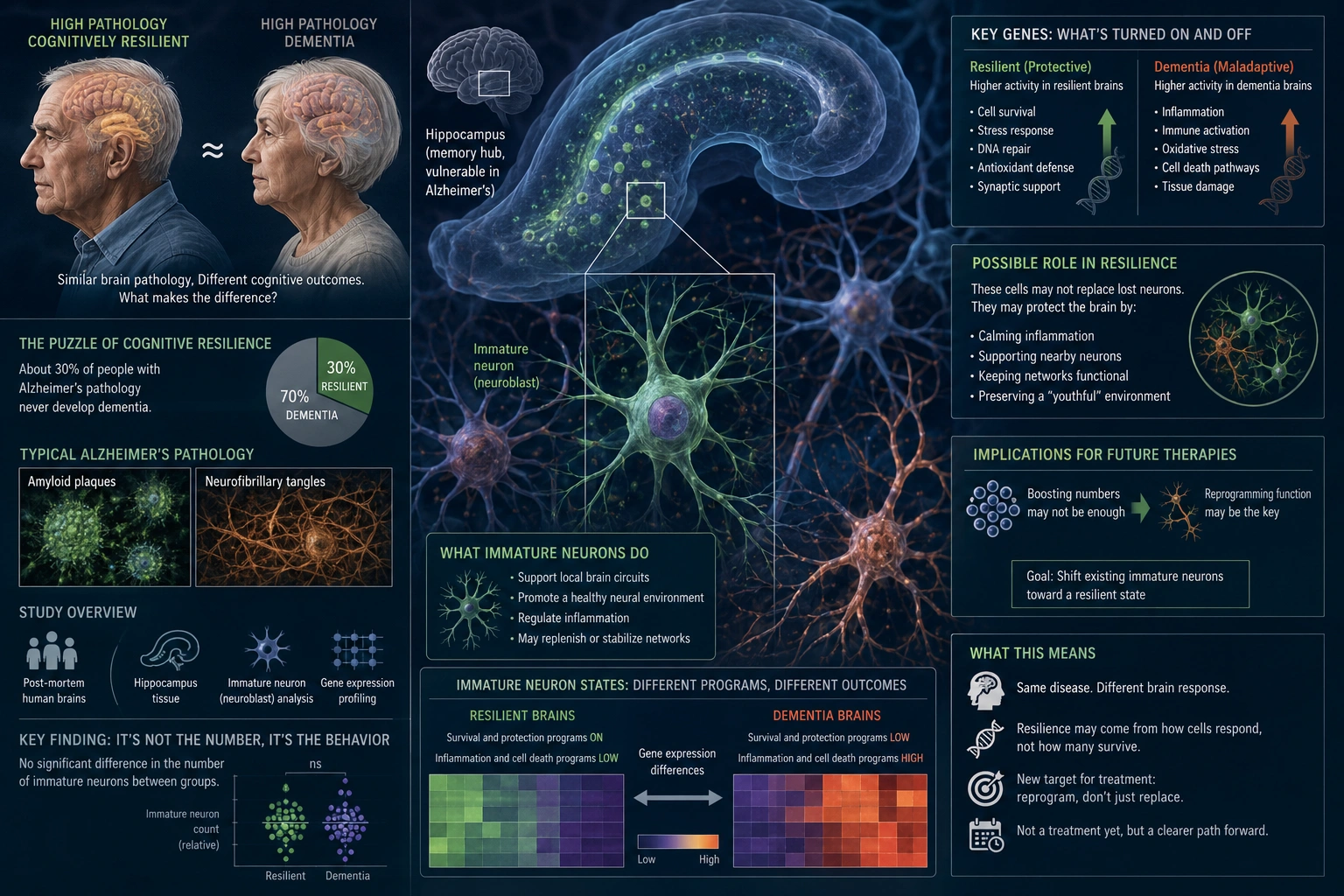
One of the more unsettling facts about Alzheimer’s disease is also one of the least discussed outside research circles. Roughly 30% of people whose brains show the full pathological signature of the disease, the plaques, the tangles, all of it, never actually develop dementia. They carry the disease and, somehow, the disease doesn’t carry them. For years, nobody could say with any confidence what separated these people from everyone else. A new study from the Netherlands Institute for Neuroscience offers one of the clearer answers yet, and it comes from an unexpected corner of the brain: a small, easily overlooked population of cells that never quite grew up.
The Puzzle of the Resilient Brain
Researchers call this phenomenon cognitive resilience, and it has puzzled the field for a simple reason. Two people can have essentially identical brain pathology on autopsy, the same protein buildup, the same structural damage, and yet one lived out their final years mentally sharp while the other lost the ability to recognize their own family. If the damage looks the same under a microscope, something else has to be doing the explaining.
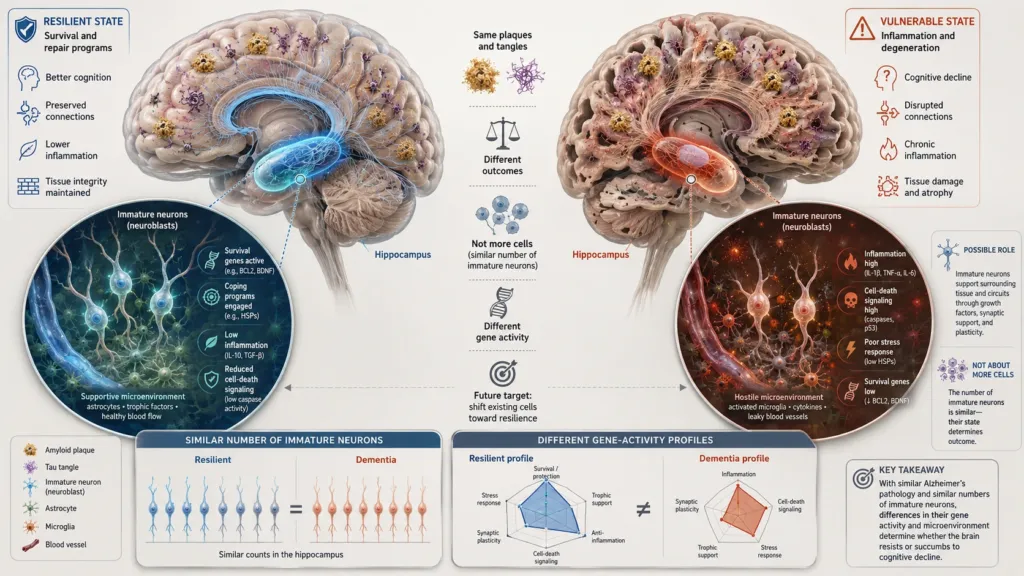
The research team, led by Evgenia Salta, focused on a population of cells known as immature neurons, sometimes called neuroblasts, found in the hippocampus, the brain region most central to memory and among the earliest areas Alzheimer’s tends to damage. These cells are, in a sense, perpetually unfinished. They exist in a kind of holding pattern, not yet fully differentiated into mature neurons, present even in very old brains. The team profiled the gene activity of these cells across brain tissue from people who had died with Alzheimer’s pathology, comparing those who had remained cognitively resilient against those who had developed full dementia.
Not More Cells, Just Different Ones
The first finding was almost a disappointment, in the way that science often disappoints before it clarifies. In brains with Alzheimer’s pathology overall, these immature neurons were reduced in number compared to healthy brains, a straightforward casualty of the disease process. But when the researchers compared resilient individuals against those with dementia, they found no meaningful difference in how many of these cells had survived. Whatever was protecting some people’s minds, it wasn’t a simple matter of having more raw material left to work with.
The real difference showed up somewhere quieter: in what the surviving cells were actually doing. In resilient individuals, the immature neurons that remained were switched on in a distinctly different way, expressing genes associated with cellular survival and coping mechanisms, and expressing far fewer of the genes tied to inflammation and cell death. As Salta put it, in resilient individuals, these cells seem to activate programs that help them survive and cope with damage. Two people, similar cell counts, and yet one set of cells appears to be quietly fighting for its life while the other has essentially given up.
What These Cells Seem to Be Doing Instead
This raises a genuinely interesting possibility that runs against a fair amount of prior thinking in the field. For years, the appeal of these immature neurons rested largely on the hope that they might mature into new, functional neurons, replacing what the disease had destroyed, a kind of built-in repair crew. This study suggests something more modest and, in its own way, more useful. The protective effect may have less to do with replacement and more to do with these cells quietly supporting the tissue around them, helping the surrounding neural environment stay functional even as the disease presses in elsewhere. Salta has described it as these cells possibly helping keep the brain, in her words, functional and youthful, rather than simply serving as raw replacement parts.
Why This Changes the Target for Future Treatment
If the difference lies in cell behavior rather than cell number, the implications for future treatment shift meaningfully. A strategy built purely around encouraging the brain to grow more of these immature neurons might miss the point entirely, since resilient and non-resilient brains had roughly the same supply to begin with. The more promising target may be figuring out how to nudge the neurons already present toward the survival-oriented, lower-inflammation state seen in resilient individuals, essentially teaching cells that are already there to behave the way a resilient brain’s cells already do on their own.
That is, admittedly, a harder problem than simply boosting a cell count. Gene expression programs are not switches that current medicine knows how to flip cleanly or safely. But it is a specific, testable target where before there was only a puzzling and largely unexplained difference between two people with the same disease.
None of this changes anything about a current diagnosis, and nobody should expect a treatment built on this insight anytime soon. What it offers, for now, is something almost as valuable in a field this frustrating: a genuine, evidence-based reason why two brains carrying the same disease can travel such different roads, and a real place to start looking for a way to help more brains take the better one.