
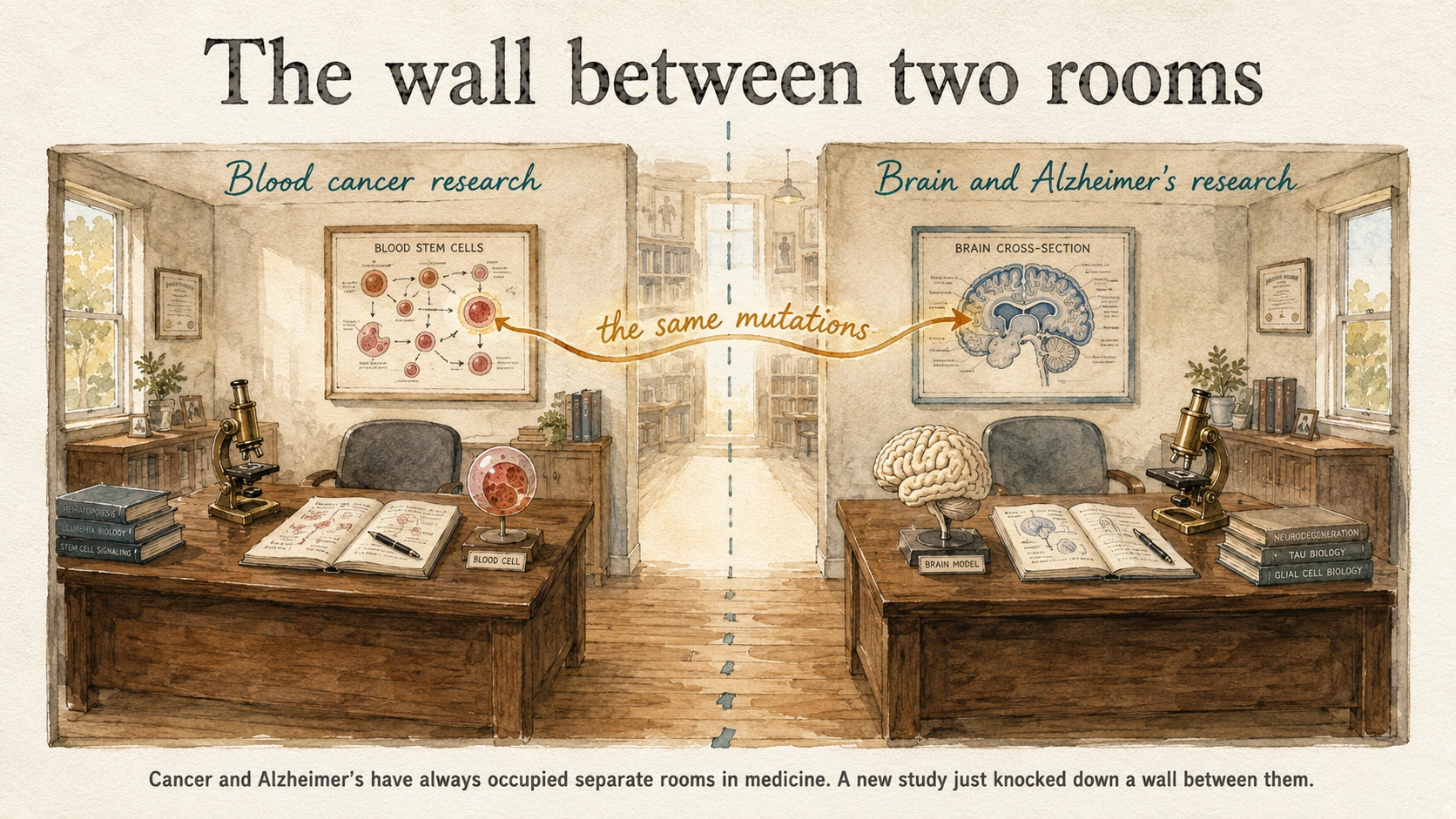
Cancer and Alzheimer’s disease have always occupied separate rooms in medicine. Different specialists, different journals, different drugs, different fears. A new study from the Icahn School of Medicine at Mount Sinai and Boston Children’s Hospital, published in the journal Cell, has quietly knocked down a wall between those rooms, and what’s been found on the other side is stranger than either field expected on its own.
How a Blood Cancer Mutation Ends Up in the Brain
The story begins with something hematologists have understood for years: as people age, their blood stem cells accumulate mutations, small errors in genes with names like DNMT3A, ASXL1, and TET2. In some people, one mutated stem cell begins to out-reproduce its neighbors, expanding into a larger and larger share of the blood supply. Doctors call this clonal hematopoiesis, and it’s long been recognized as a quiet risk factor for blood cancers like leukemia.
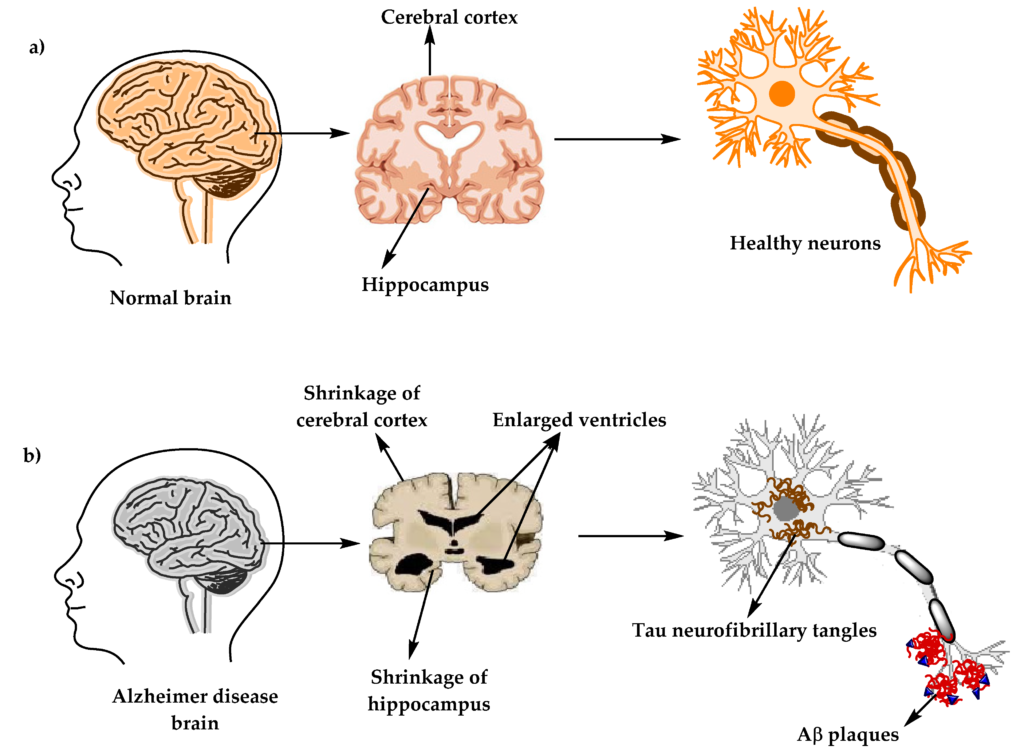
What nobody expected was to find the same mutations sitting inside the brain. Researchers led by Eirini Papapetrou, who directs Mount Sinai’s Center for the Advancement of Blood Cancer Therapies, and neuroscientist Samuele Marro, examined microglia, the brain’s resident immune cells, in tissue from people who had died with Alzheimer’s disease. There they were: the same cancer-associated mutations that show up in aging blood.
The likely explanation is almost architectural. Microglia aren’t born in the brain. They begin as immune cells that migrate there, typically early in development, but the blood-brain barrier that normally keeps the brain sealed off from the rest of the circulatory system weakens with age, and further still in Alzheimer’s disease. Boston Children’s researchers Alice Eunjung Lee and August Yue Huang, working alongside Christopher Walsh, found the same mutations in blood samples from the same patients, suggesting these mutations very likely arose first in the blood, in cells that later crossed into the brain and settled in as microglia, carrying their genetic errors with them.
What These Mutated Cells Actually Do Once They Arrive
Here is where the story takes its strangest turn. In blood, these mutations tend to build toward cancer, an uncontrolled proliferation of cells that eventually overwhelms the marrow. In the brain, the same mutations don’t produce a tumor. Microglia carrying them don’t become malignant. Instead, they become something closer to permanently agitated, locked into an inflammatory, hyperactive state that keeps attacking and damaging the neurons around them, the very tissue they’re supposed to be protecting.
The research team confirmed this wasn’t coincidence by building the mutations from scratch. Using CRISPR gene editing, they engineered stem cell-derived microglia-like cells to carry the exact mutations found in patient brain tissue. Those engineered cells adopted the same inflammatory gene expression patterns seen in Alzheimer’s brains, on command, in a dish. As Papapetrou put it, the mutations can directly alter the behavior of brain immune cells. Not correlate with it. Alter it.
A Risk Factor Separate From the One Everyone Already Knows About
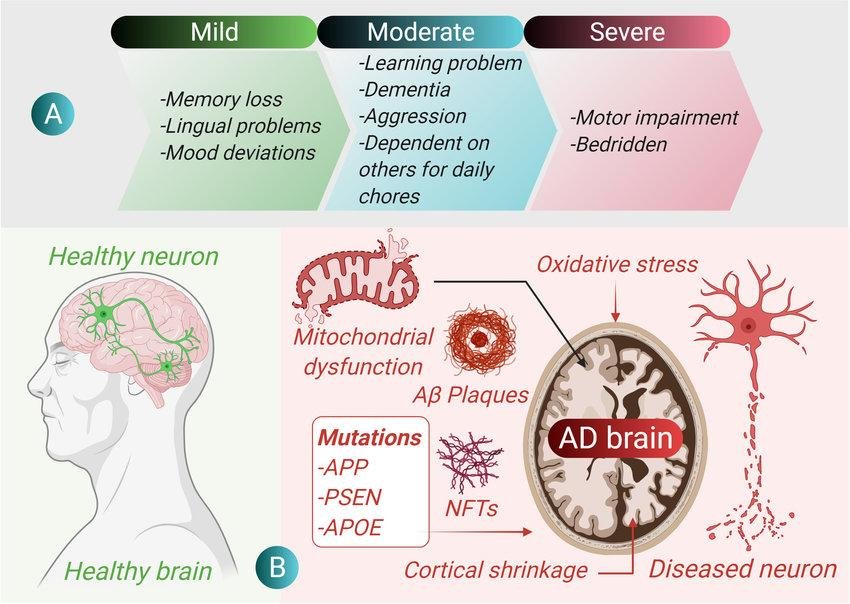
For three decades, the dominant genetic story in Alzheimer’s research has centered on a single gene, APOE4, the best established inherited risk factor known to science. A follow-up study by Lee and Huang, now available as a preprint, tested whether these newly discovered blood cancer mutations were simply another expression of that same old risk, or something genuinely separate. The mutations raised Alzheimer’s risk independently of APOE4 status. A person could carry none of the usual genetic warning signs and still be at elevated risk through this entirely different route, a route nobody had reason to look for until blood cancer research and brain research happened to collide.
Why This Could Matter Faster Than Most Alzheimer’s Discoveries
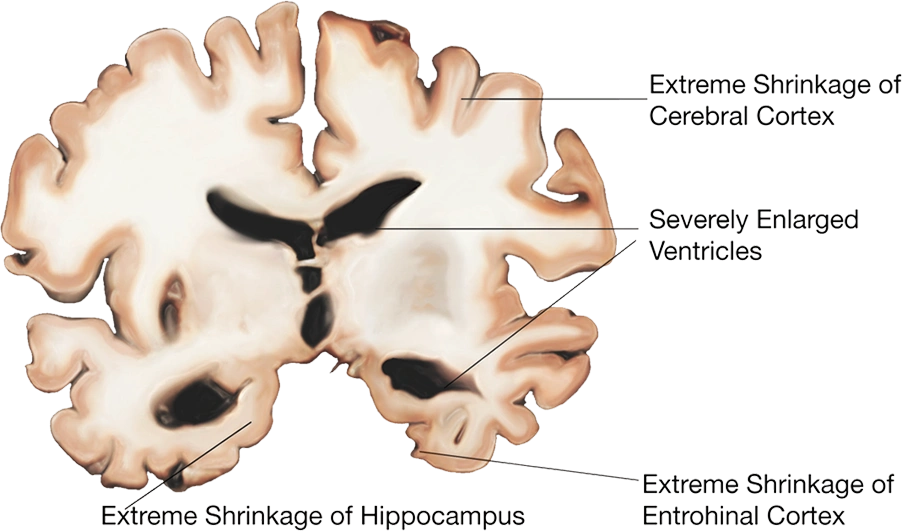
Most findings at this stage, a described mechanism, a set of engineered cells in a dish, are years and years removed from anything a patient would notice. This one may move faster than that, for an unusually practical reason. The same clonal hematopoiesis mutations have already been studied extensively in oncology, because they matter for blood cancer risk. Diagnostic blood tests for detecting them already exist. Drugs that target the pathways these mutations disrupt have already been developed and, in some cases, approved for use in blood cancers.
That means two things researchers wouldn’t ordinarily get to say together about a new Alzheimer’s mechanism. First, a blood test, rather than a brain scan or spinal tap, could plausibly screen for this specific risk factor, since the mutation is detectable in blood in the first place. Second, some of the medicine already sitting on pharmacy shelves for cancer patients might, in principle, be worth testing against Alzheimer’s, not because someone invented a new drug, but because the old one may already fit a lock nobody knew it could open.
None of this changes anything for a family managing a diagnosis today. The blood tests aren’t validated for Alzheimer’s risk screening yet, and no cancer drug has been tested in Alzheimer’s patients on the strength of this finding alone. What’s changed is the map. Two diseases that seemed to live in entirely separate biological neighborhoods turn out to share a fence line, and somewhere along that fence line may be the beginning of a genuinely new way to catch, and maybe someday treat, a disease that has resisted nearly everything thrown at it so far.