
Everyone already knows exercise keeps older muscles stronger. What’s been missing is the why, the actual biological mechanism sitting underneath that advice doctors have been giving for decades. A new study out of Duke-NUS Medical School in Singapore, working with collaborators at Singapore General Hospital and Cardiff University, just filled in that gap, and the answer comes down to a single gene most people have never heard of.
The Switch That Falls Out of Balance With Age
The gene is called DEAF1, and think of it as a kind of internal thermostat for muscle repair. Deep inside every muscle sit small reserves of stem cells, the cells responsible for repairing damage and rebuilding strength after any kind of physical stress. As muscles age, those stem cells naturally become less effective, and the Duke-NUS team found a specific reason why: DEAF1 levels climb with age, and that rise throws off a repair pathway called mTORC1, the internal signaling system that tells stem cells when to get to work.
Exercise, it turns out, pushes back directly against that. Physical activity suppresses DEAF1, which allows mTORC1 to normalize again, which in turn lets aging muscle stem cells do their actual job, clearing out cellular debris and rebuilding tissue the way they did decades earlier. Priscillia Choy Sze Mun, the study’s first author and a research assistant in Duke-NUS’s Cancer and Stem Cell Biology Program, put it simply: exercise tells aging muscle to clean up and reset. She described the effect as almost like hitting the rewind button.
Why This Matters Even for People Who Can’t Exercise Much

Here’s where this stops being just another reason to take a walk and becomes something genuinely useful for people managing serious limitations. A lot of older adults recovering from surgery, illness, or chronic conditions like cancer simply can’t exercise enough to get this benefit through movement alone, at exactly the moment their muscles need it most.
Because the researchers identified a specific molecular target, DEAF1 itself, rather than just observing that “exercise helps,” it opens a real possibility down the road: a treatment that mimics exercise’s repair signal at the cellular level, for people whose bodies won’t currently let them earn it through activity. Professor Patrick Tan, Duke-NUS’s Senior Vice-Dean for Research, has pointed to that translational angle as one of the more promising parts of the findings, published in the Proceedings of the National Academy of Sciences.
None of that replaces movement for people who are able to move. But it does mean the science is no longer just saying “exercise is good for aging muscles” and stopping there. It’s naming the actual switch being flipped, which is the first real step toward helping the people exercise currently can’t reach.
What to Actually Take From This
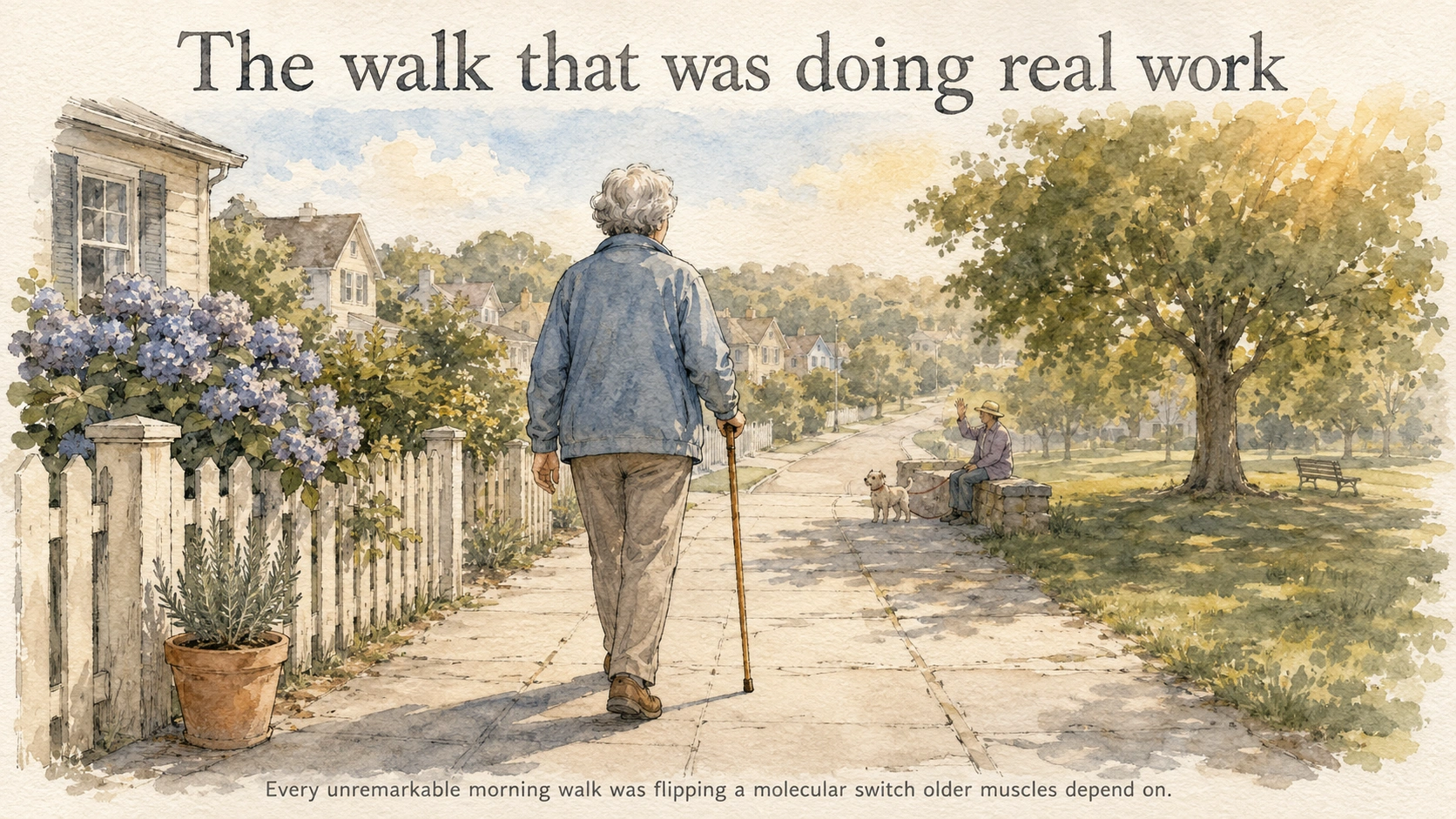
For most older adults, the practical message hasn’t changed, and honestly it’s a reassuring one rather than a complicated new instruction. Regular physical activity, even the kind that doesn’t feel intense, appears to be doing real, specific, measurable work at the cellular level, correcting an imbalance that would otherwise just get worse with age. For a family supporting a parent who’s already exercising regularly, that’s confirmation the effort is doing exactly what it looks like it’s doing. For a family supporting someone who currently can’t, this research is the first real hint that help might eventually come in a form that doesn’t require a gym.