

Nearly 60% of American adults take some kind of dietary supplement, and glucosamine is one of the most routine choices on that list. Tens of millions of older adults take it daily for joint pain and osteoarthritis, buy it off the shelf at any pharmacy or grocery store, and never think to mention it at a doctor’s visit, because why would they. It’s not a prescription. It’s cartilage in a capsule, marketed as harmless.
A new study out of the University of Florida is asking whether that assumption holds up for a specific group of people, and the early answer is uncomfortable.
A 25% Jump in Progression, and a Mortality Risk That Only Showed Up in One Group
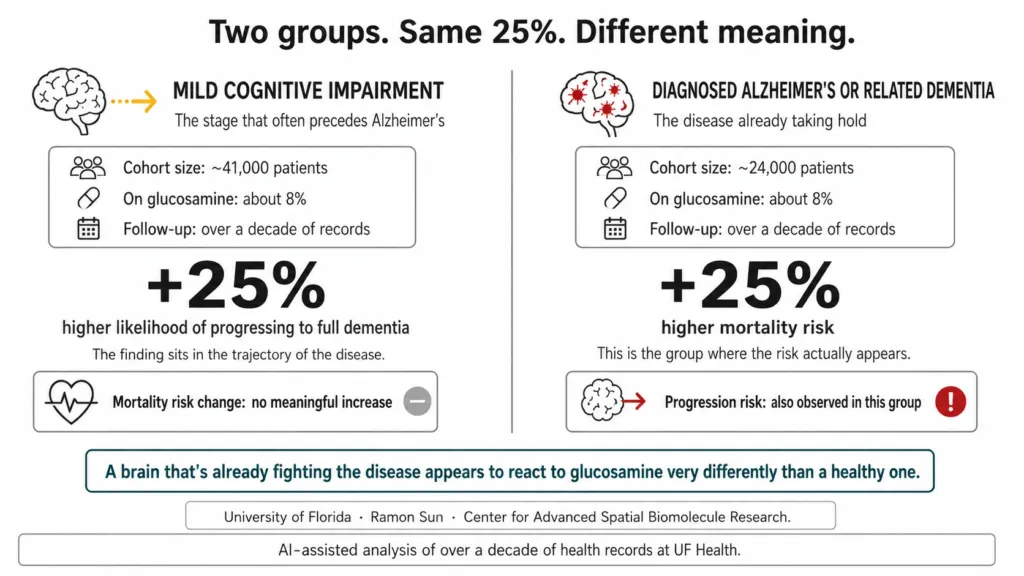
Researchers used artificial intelligence to comb through more than a decade of deidentified health records at UF Health, covering roughly 24,000 patients with dementia and 41,000 with mild cognitive impairment, the diagnosis that often, though not always, comes before Alzheimer’s. About 8% of both groups reported taking glucosamine. After controlling for age, sex, and other demographic factors, the researchers found something that should give a lot of families pause.
Glucosamine use was associated with a 25% higher likelihood of progressing from mild cognitive impairment to full dementia. Among people already diagnosed with Alzheimer’s or a related dementia, glucosamine use was also linked to a 25% increase in mortality risk.
Here’s a detail worth noticing, because it says something real about who’s actually vulnerable here. That mortality increase didn’t show up in the mild cognitive impairment group at all, only in people whose Alzheimer’s had already taken hold. In other words, a brain that’s already fighting the disease appears to react to glucosamine very differently than a healthy one does.
How a Joint Supplement Ends Up Affecting the Brain
So why would a joint supplement have anything to do with the brain in the first place? Because glucosamine doesn’t stay in the joints. It crosses the blood-brain barrier, the same protective filter that’s supposed to keep most substances out of brain tissue. Once inside, the research team found it fuels something called protein glycosylation, essentially a sugar-tagging process that attaches sugar molecules onto proteins. That process is already overactive in Alzheimer’s brains. Adding glucosamine into that mix, the researchers found in genetically modified mice and confirmed by scanning actual human Alzheimer’s brain tissue, appears to push an already disrupted system further off balance.
Senior researcher Ramon Sun, who directs UF’s Center for Advanced Spatial Biomolecule Research, has pointed out that roughly 7 million Americans currently live with Alzheimer’s, with millions more affected by related dementias. That’s the scale this finding sits against.
What This Study Can’t Prove Yet
His colleague, biochemistry chair Matt Gentry, was careful to note that this is an association drawn from health records, not proof that glucosamine causes faster decline. But he also said it’s a real clinical question that deserves a lot more attention than it’s gotten so far.
That distinction matters, and it’s worth taking seriously rather than glossing over. Retrospective health record studies can’t prove cause and effect the way a controlled clinical trial can. Other explanations are possible. People with more joint pain and inflammation generally might simply be more likely to both take glucosamine and develop faster cognitive decline for entirely separate reasons. The researchers know this, which is exactly why they’re calling for a real clinical trial before anyone treats this as settled.
What to Actually Do With This Right Now
What it does mean, right now, today, is something simpler and more practical. If a parent or spouse has been diagnosed with mild cognitive impairment or Alzheimer’s and has also been quietly taking glucosamine for their knees for years, that’s a detail worth bringing to their next neurology or primary care appointment, not because the case against it is closed, but because it clearly isn’t as harmless a question as it looked a year ago.