
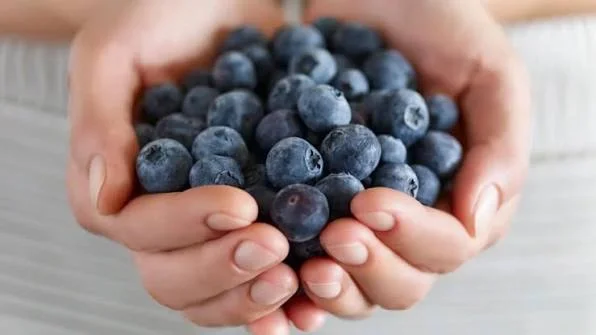
Eighteen adults over 65 with mild depressive symptoms finished a three-month trial of daily blueberry powder, with mood scores that improved more than the placebo group’s, though the difference wasn’t large enough to count as statistically significant. Hebrew SeniorLife announced the results in early September, after the paper appeared in the Journal of Nutrition, Health and Aging on August 21.
An earlier trial in rural Louisiana, in adults with diagnosed depression or anxiety, did report a significant drop in symptoms on the berries. The two studies lean in one direction. Each is a pilot with a small group.
Daily blueberry powder lined up with better mood scores in two small pilot trials, but studies this size can’t show that the fruit treats depression.
Mood Scores Improved More On Blueberry Powder, But Not By Enough To Count
In the older-adult trial, the berry group (10 people, average age 71) showed a larger and steadier drop in depressive symptoms than the placebo group (8 people, average age 75). The difference between groups wasn’t statistically significant, and the coverage gives no scores or p-values.
The authors call the data preliminary and say it “warrant[s] additional studies,” according to LCGC International’s write-up.
Two Small Trials Tested Different Doses On Different People
The Older-Adult Trial Used About Two Cups Of Berries In Powder Form
Sedentary adults 65 and older were randomly assigned to 48 grams of freeze-dried powder a day, roughly two cups of fresh berries, or a matched placebo powder. Participants and assessors alike were kept in the dark about who got which. SciTechDaily’s coverage adds that most participants were women and most were White. Enrollment and dropout numbers weren’t reported.
The Louisiana Trial Used Half That Dose On Adults With Diagnosed Disorders
Adults in rural Louisiana with major depressive disorder, generalized anxiety disorder or a mix of the two, all receiving standard care, took 24 grams of whole-berry powder daily (about one cup of fresh fruit) or a placebo for 12 weeks. Produce Market Guide’s report puts the group at 23 adults and says the berry group had a greater drop in depression and anxiety scores.
Symptoms were measured with the Hamilton Depression Rating Scale, the GAD-7 anxiety questionnaire and the Major Depression Inventory. The paper, in Nutrients (2025;17:3720), has Joseph Francis of Louisiana State University as lead author. Effect sizes weren’t available in the sources.
Gut Gene Changes Showed Up While Gut Chemistry Stayed Put
In the older-adult trial, the mix of bacterial species, the metabolic pathways and the short-chain fatty acids in stool all stayed steady. Within the berry group alone, several groups of bacterial enzyme genes shifted, including polyamine-transporting ATPase. The enzyme is involved in making GABA, a calming brain chemical, but gene changes by themselves don’t show that more GABA was made or that mood was affected.
Lead author Courtney Millar of the Marcus Institute for Aging Research said, “Fiber and anthocyanins in blueberries have potential to modify the gut microbiome.” Her team’s stated objective was to preliminarily determine the effect of blueberry consumption.
The Louisiana team looked at inflammation too. C-reactive protein and the inflammatory cytokines they measured didn’t change, so inflammation isn’t an obvious explanation. The authors say the biochemical mechanisms behind the improvement “remain unresolved.”
A Few Details Make These Trials Hard To Compare
- Size: 18 completers in the older-adult trial and 23 participants in the Louisiana one.
- Dose: 48 grams a day in one, 24 grams in the other.
- Patients: mild symptoms in sedentary older adults, against diagnosed disorders already in treatment.
- Form: each trial used freeze-dried powder, so the results can’t be carried over to a bowl of fresh berries.
- Funding: the older-adult trial lists a USDA AFRI NIFA grant. The Louisiana paper appears in the blueberry council’s research library under a label crediting the U.S. Highbush Blueberry Council, the growers’ promotion group. The pages available don’t spell out who paid.
Don’t Swap Blueberries For Your Prescription Or Therapy
Berries are a food that might help mood, and nothing in these trials makes them a treatment. Produce Market Guide notes that blueberries aren’t a replacement for medication or psychiatric care, while the Louisiana volunteers were all on standard care when they took the powder.
Anyone with low mood that lingers should talk with a doctor or mental health professional. In the U.S., calling or texting 988 connects you to the Suicide & Crisis Lifeline at any hour.
For more on daily habits and mood, see our earlier pieces on a simple daily routine linked to less pain and depression and on how gut bacteria tie into type 2 diabetes risk.