

PCSK9 inhibitors have existed for years, and by most measures they work well, cutting LDL cholesterol by roughly half in people who couldn’t get there with statins alone. What they’ve never had is a pill. Repatha and Praluent, the two injectable versions on the market, require a needle every two weeks or once a month, and that single detail has kept plenty of patients who could benefit from ever starting the drug at all. Doctors have pointed to the injection itself, not the medication’s effectiveness, as one of the biggest reasons this drug class has stayed underused.
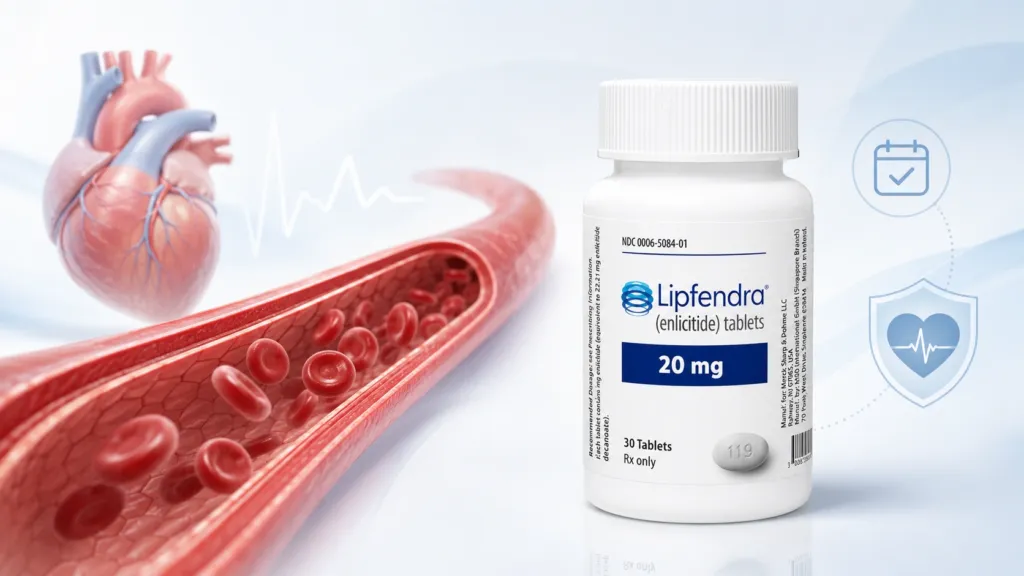
That barrier is gone now. The FDA has approved Lipfendra, known generically as enlicitide, as the first oral PCSK9 inhibitor available in the United States, a once-daily 20-milligram tablet made by Merck.
What the Trials Actually Showed
Lipfendra works through a mechanism called a macrocyclic peptide, a fairly new category of drug chemistry that lets a molecule act like an antibody while still being small enough to survive as a pill instead of requiring an injection. It binds to circulating PCSK9, a liver protein that normally marks LDL receptors for breakdown. Block PCSK9, and more of those receptors stay active, pulling more LDL cholesterol out of the bloodstream.
Two Phase 3 trials backed the approval. In CORALreef Lipids, which enrolled patients already on stable statin therapy but still needing further LDL reduction, Lipfendra cut LDL cholesterol by 56% compared with placebo at 24 weeks, starting a full response as early as week 4 and holding through a year of treatment. Non-HDL cholesterol dropped 54%. Apolipoprotein B, another marker tied to cardiovascular risk, fell 50%. A second trial, CORALreef HeFH, focused on a genetic condition that drives dangerously high cholesterol from a young age, heterozygous familial hypercholesterolemia, and found a 59% reduction. Side effects stayed close to placebo levels overall, though diarrhea and dizziness showed up more often in the HeFH group. No signs of liver injury, no meaningful effect on blood sugar.
Marc Siegel, Fox News’s senior medical analyst and not involved in developing the drug, called the oral version well-tolerated and just as effective as its injectable predecessor, which is about as clean an independent verdict as a new drug tends to get this early.
The Question This Approval Doesn’t Answer Yet
Here’s what Lipfendra hasn’t proven, and it matters. Everything above concerns cholesterol numbers, not the outcomes those numbers are supposed to predict: heart attacks, strokes, cardiovascular death. A separate, much larger trial called CORALreef Outcomes has already finished enrolling more than 14,500 participants specifically to answer that harder question, and Merck has said results aren’t expected until 2029. Lowering LDL cholesterol is strongly associated with fewer cardiovascular events across decades of research on other drugs in this space, so the expectation runs in Lipfendra’s favor. It just isn’t proven for this specific medication yet, and anyone weighing the drug’s value should know that gap exists rather than assume the LDL numbers alone tell the whole story.
For families managing an older relative’s heart health, that distinction is worth bringing up directly at the next cardiology visit, particularly for anyone who has been avoiding an injectable PCSK9 inhibitor specifically because of the needle. A pill removes the barrier that’s kept a genuinely effective drug class out of reach for a lot of people who needed it, the same access gap that shows up again in broader prevention research whenever a real treatment exists but the delivery method keeps people from actually using it. What Lipfendra can’t yet promise is the harder proof that matters most, and won’t be able to for a few more years.