

Every geriatrician has some version of the same story. A patient comes in tired all the time, unsteady on their feet, a little foggier than they used to be, maybe some tingling in the fingertips that comes and goes. The chart gets a note: consistent with normal aging. The patient goes home with reassurance and, sometimes, nothing else.
New research says that reassurance might be wrong more often than anyone realized, and the culprit hiding underneath it might be something as unglamorous as a vitamin.
The Symptoms That Get Waved Away as Just Getting Older
Vitamin B12 does a strange amount of heavy lifting for something the body needs in microscopic quantities. Adults require roughly 2 micrograms a day, an amount so small it weighs less than a single fragment of a grain of table salt. That tiny allotment keeps red blood cells forming correctly, keeps nerves properly insulated, and plays a role in building DNA itself.
When B12 runs low, the results read almost exactly like a checklist for getting older:
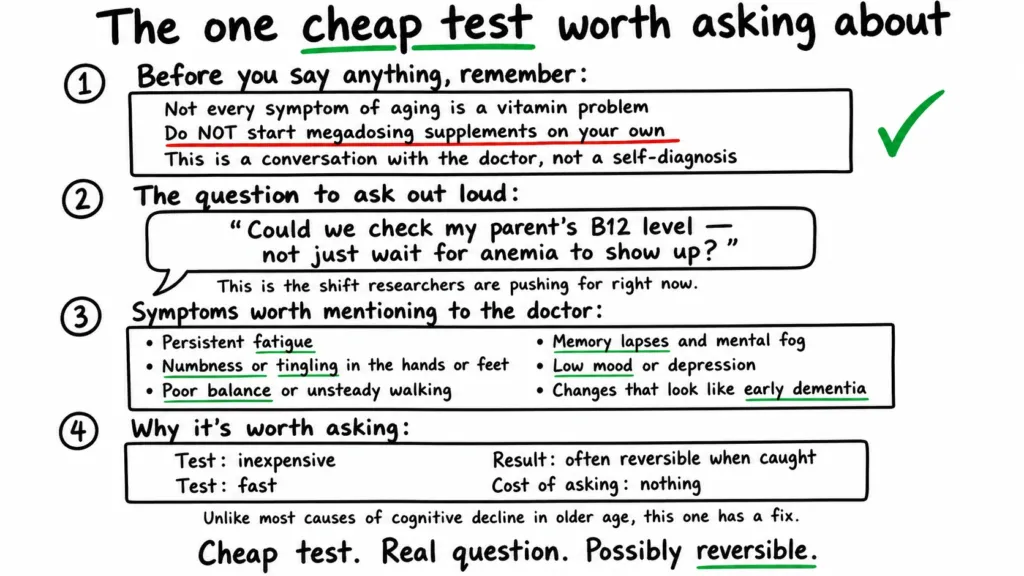
- Persistent fatigue
- Numbness or tingling in the hands and feet
- Poor balance or difficulty walking
- Memory lapses and mental fog
- Depression
- In more advanced cases, cognitive changes that look, on the surface, indistinguishable from early dementia
That overlap is precisely the problem. None of those symptoms point specifically at B12. They point at almost anything, including the ordinary, unavoidable process of aging itself, which is exactly why deficiency slips through so easily.
What a New UCSF Study Actually Found in People With “Normal” Levels
One detail here should make any family reconsider what “normal” actually means on a lab report. Researchers at the University of California, San Francisco studied older adults whose B12 levels fell within the officially normal range, but toward its lower edge. These weren’t people flagged as deficient on a standard blood test. By the numbers, they were fine.
They weren’t, functionally. The people trending toward the low end of “normal” showed slower thinking speed, delayed visual processing, and measurable damage to the brain’s white matter, the wiring that lets different brain regions actually communicate with each other. In other words, the line doctors currently use to decide who’s fine and who isn’t may be drawn in the wrong place entirely.
That distinction matters enormously once you look at how many people it could apply to. An estimated 6% of adults under 60 are deficient or borderline. Past 60, that number climbs to nearly 20%, almost one in five. For a population that size, moving the line even slightly changes who gets caught by it and who slips through.
Why This Happens More as the Body Ages
There’s a fairly mundane biological reason older adults end up deficient more often, and it starts in the stomach. Absorbing B12 from food requires adequate stomach acid to release the vitamin from protein, plus a substance called intrinsic factor to carry it into the bloodstream. Stomach acid production tends to decline with age on its own. Some older adults also develop autoimmune gastritis, a condition where the immune system damages the very stomach cells responsible for producing both acid and intrinsic factor.
A few other common realities of aging compound the problem. Weight-loss surgery can reduce absorption. Certain medications prescribed for diabetes or acid reflux, both common in older adults, interfere with it too. And since B12 occurs almost exclusively in animal-based foods, anyone following a plant-based diet, at any age, faces the same basic supply problem from a different angle.
None of it shows up as a dramatic event. It’s a slow leak, not a break, which is exactly why it gets misread as the gradual erosion everyone expects from age instead of a specific, fixable shortfall.
How B12 Deficiency Drains Muscle Energy Before Anemia Shows Up
A second thread of research, separate from the UCSF findings, is reshaping how scientists think about B12 altogether. A team at Cornell University, led by Dr. Martha Field and working with collaborators at the University of Alabama at Birmingham, found that B12 deficiency interferes with the DNA inside mitochondria, the structures inside every cell responsible for producing usable energy. Specifically, low B12 triggers a buildup of a compound called uracil inside mitochondrial DNA, and that buildup appears to bring energy production to a halt.
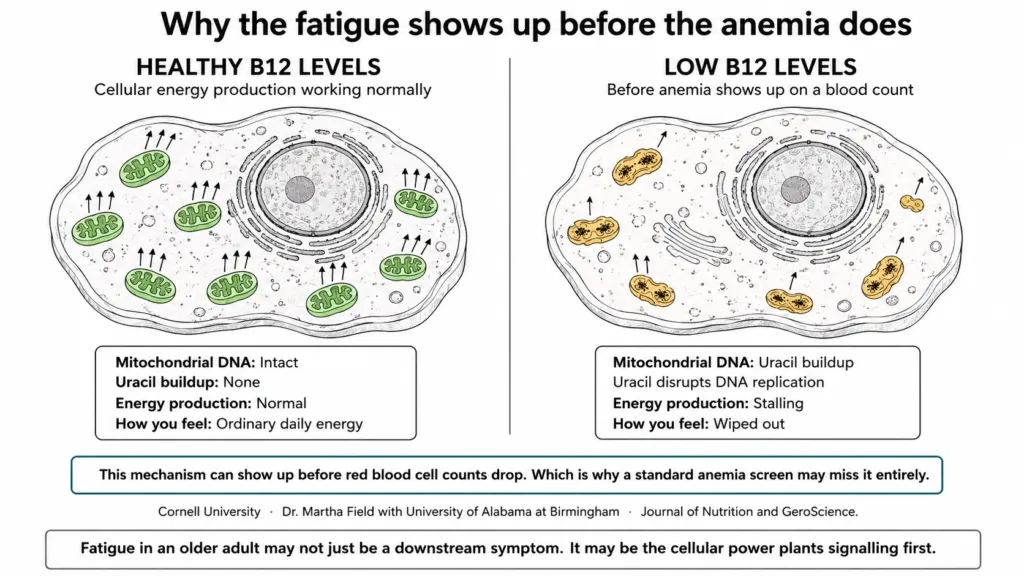
So why would someone feel wiped out long before a standard blood count ever flags anemia? The research, published in the Journal of Nutrition and followed by related work in GeroScience, included a study in aged female mice led by co-author Abigail Williamson. Giving those mice B12 supplements improved several measures of mitochondrial health, including the actual number and structure of the mitochondria themselves. Fatigue, it turns out, may not just be a downstream symptom of a red blood cell problem. It may be a direct signal that the body’s cellular power plants are struggling, and that signal can show up early enough that a standard anemia screen misses it entirely.
The researchers themselves are careful here, and it’s worth repeating that caution just as plainly: none of this means megadosing on B12 will reverse aging or hand anyone extra energy if their levels are already fine. What it does mean is that fatigue in an older adult deserves a real look at B12 status, not an automatic shrug.
A Discovery a Century in the Making
There’s a strange kind of symmetry to all this landing in 2026, which happens to mark the 100th anniversary of one of the more overlooked breakthroughs in modern medicine. In 1926, George Minot and William Murphy reported that a liver-rich diet could treat pernicious anemia, at the time a frequently fatal disease with no real treatment. Their work eventually led scientists to isolate vitamin B12 itself as the substance responsible.
The trail that got them there started somewhere stranger. Years earlier, physician and pathologist George Whipple had noticed that feeding liver to dogs helped them recover from anemia caused by blood loss, an unrelated condition. That odd observation about dogs became the thread that, eventually, unraveled the mechanism behind a disease that had been killing people with no explanation at all.
A hundred years later, the same vitamin is still surprising researchers, just more quietly. It went from curing a fatal disease to, potentially, explaining why an aging parent seems more tired and foggier than they should be.
What to Actually Ask at the Next Doctor’s Visit
Nobody’s suggesting every symptom of aging is secretly a vitamin problem, and no responsible clinician would make that leap either. What this research does suggest is that the current default, waiting for full-blown anemia before checking B12, may be missing people whose deficiency is already affecting how they think, walk, and feel, well before a standard blood count would ever catch it.
Researchers are now pushing for B12 screening to become a routine part of evaluating older patients who show up with fatigue, cognitive complaints, or unexplained numbness and tingling, rather than a test doctors reach for only after other explanations run out. For a family watching a parent decline and wondering how much of it is simply age, that’s a real, concrete, and cheap question worth putting on the table at the next appointment.
A blood test that measures serum B12 is inexpensive, it’s fast, and unlike most causes of cognitive decline in older age, this one, when caught, is often reversible.