

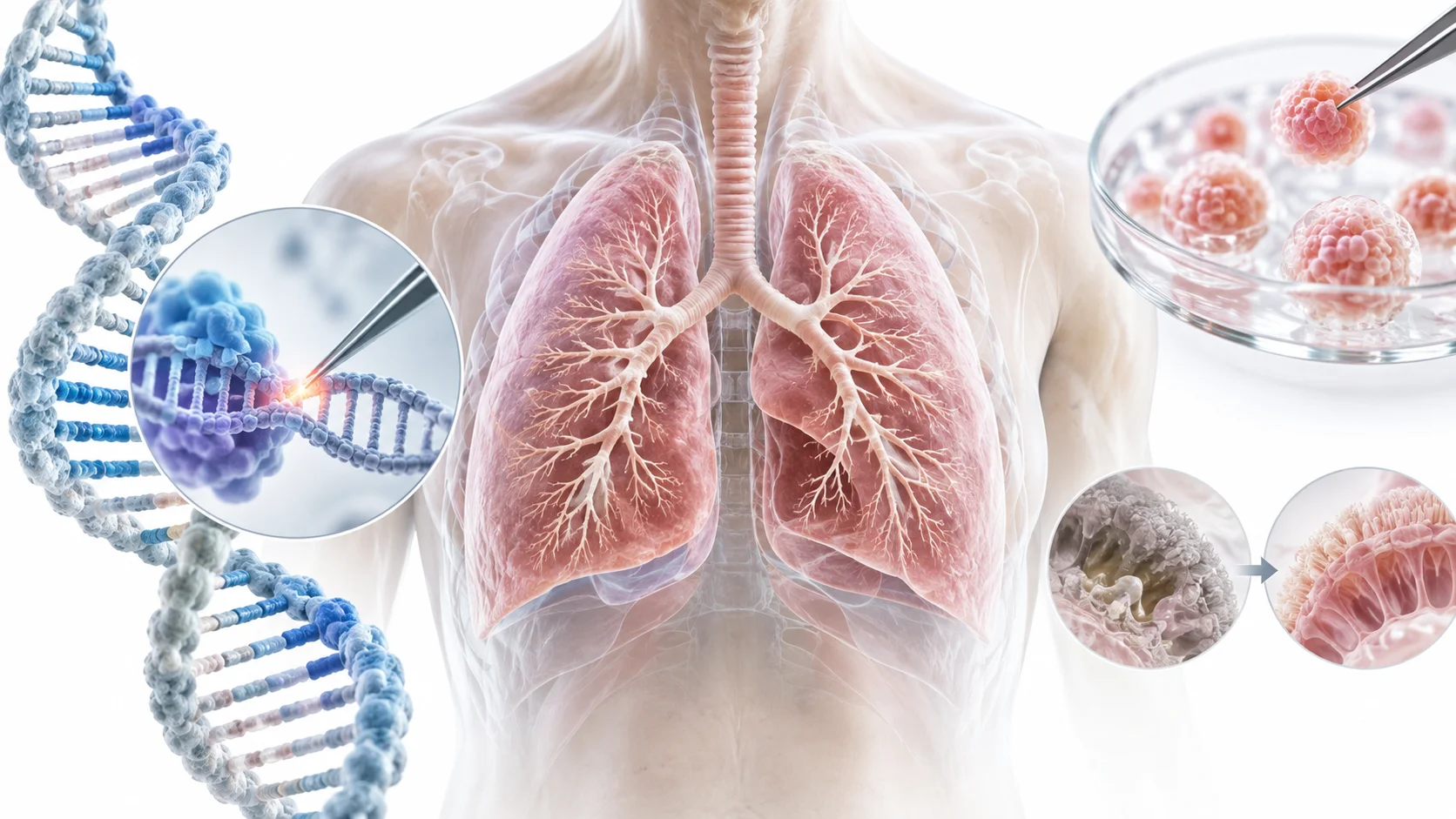
Modulator drugs are now the mainstay of cystic fibrosis treatment, and they leave a smaller group of patients standing outside the door. A modulator works by nudging a faulty CFTR protein back into shape, which only helps if the cell is making the protein at all. Some mutations, the nonsense and splicing kind, stop production before it starts, so there is nothing to nudge. One of them, called 1717-1G>A, still has no approved drug treatment of any kind.
That gap is where gene editing has been aiming, and several labs published results this year that move the idea from theory toward something measurable. None of the studies involved a patient. Every one used cells or organoids grown in a dish, which is worth keeping in mind while reading the numbers.
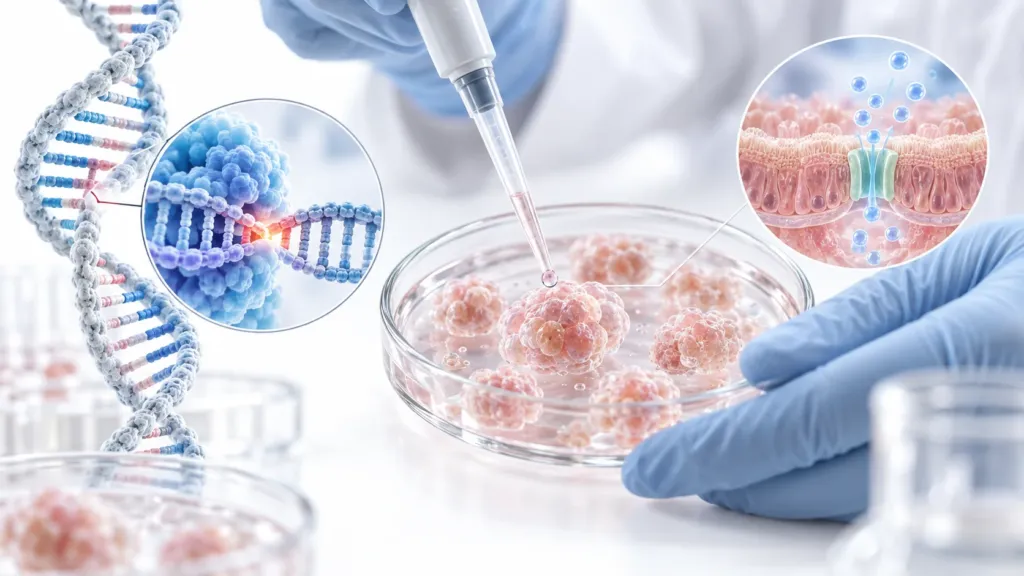
Umbach and colleagues, writing in Science Translational Medicine, went after 1717-1G>A directly. The mutation breaks a splice site in the CFTR gene, so the cell garbles the message and never builds the protein. Their tool was an adenine base editor, which swaps a single DNA letter without cutting the strand, delivered as RNA rather than DNA. Editing reached as much as 30 percent in some cell lines and about 13 percent overall in patient-derived models, with minimal off-target effects, and CFTR activity came back in intestinal organoids grown from patients’ own cells.
UCLA researchers tried something bigger. Instead of fixing one letter, they used lipid nanoparticles to carry CRISPR components that slot an entire healthy CFTR gene into airway cells, without viral vectors, which traditional gene therapy has depended on and which have been a major limitation. The cells carried a severe mutation existing drugs don’t touch. Adding a whole working copy means the method doesn’t care which mutation broke the original, hence the label mutation-agnostic.
Then comes the unglamorous work of making the tools less sloppy. Gang Bao’s group at Rice University refined a base editor so it stops acting on neighboring letters, and showed they could introduce cystic fibrosis mutations into human epithelial cells and reverse them again, evidence of “the level of pinpoint gene-editing control this technology now offers,” Bao said. A London-led team used receptor-targeted nanoparticles to carry an editor into airway cells with the G542X mutation. And a first single-cell analysis of base-edited primary airway cells began answering which cell types actually get corrected, and what happens to them afterward.
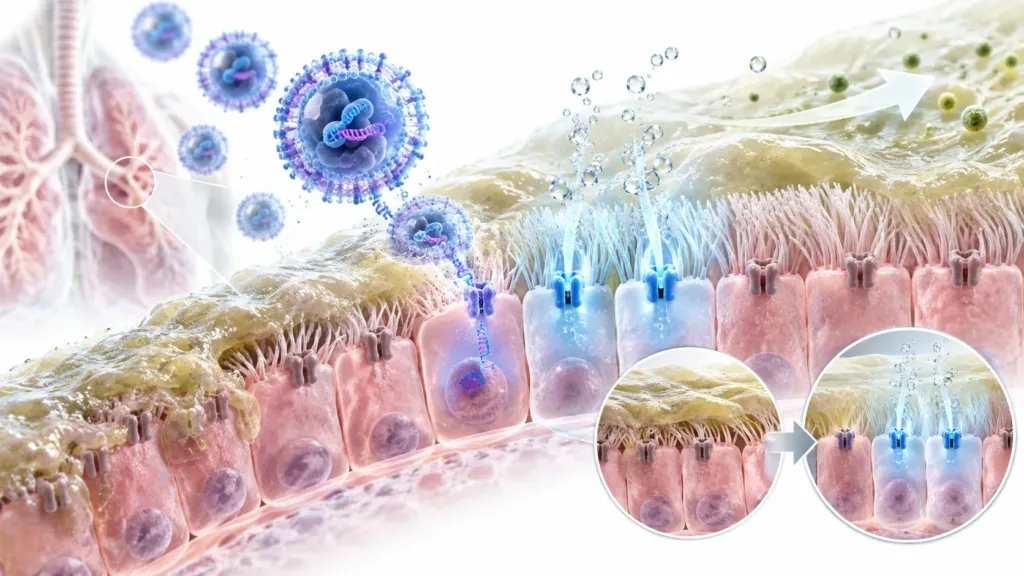
What these efforts share is the part nobody has solved. Getting an editor into a dish is easy next to getting it into the right cells inside a living lung, and researchers have long named delivery to airway basal cells, the ones that replenish the lining, as the standing hurdle. For contrast, the CAR T trial in rheumatoid arthritis at least reached six patients. Nothing in cystic fibrosis editing has gotten that far yet.
The number worth remembering is a small one. UCLA’s method corrected only 3 to 4 percent of the cells and still restored 88 to 100 percent of normal CFTR function in the lab-grown airway tissue. Earlier work had suggested that roughly 10 percent editing may be enough for functional recovery, and these results lean the same direction: a cystic fibrosis lung may not need every cell repaired, only enough working ones to keep salt and water moving. That lowers the bar considerably for whoever eventually works out how to reach it.