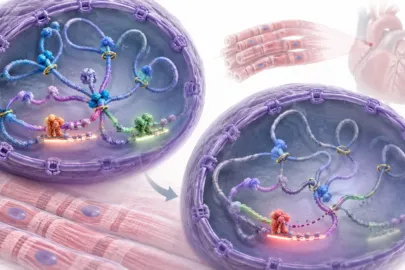


About one in five people carries at least one copy of APOE4, the strongest common genetic risk factor for Alzheimer’s disease, and yet a small group of carriers stays free of symptoms well into their 80s. A team at Columbia University has been studying what sets those people apart, and a new paper in Nature Aging explains how the leading suspect, a rare variant in a gene called FN1, could be doing the protecting.
The variant itself is not new. Columbia’s 2024 discovery, published in April of that year, came from sequencing the genomes of several hundred APOE4 carriers over age 70, many of them enrolled in the Washington Heights/Inwood Columbia Aging Project in Northern Manhattan. A group from Stanford and Washington University found the same variant in an independent, mostly European-ancestry cohort, and together the two teams analyzed about 11,000 people. The variant was linked to 71% lower odds of Alzheimer’s in APOE4 carriers and, among carriers who still developed the disease, to onset about four years later. The researchers estimated that 1% to 3% of APOE4 carriers in the US, roughly 200,000 to 620,000 people, might have it. The finding has also been summarized for the public on NIH’s Alzheimer’s portal.
What the 2026 paper adds is a mechanism. Published as “Fibronectin mediates APOE4-driven blood-brain barrier dysfunction in Alzheimer’s disease” in Nature Aging, the work was led by Caghan Kizil, a professor of neurological sciences at Columbia, and the Columbia release carrying it was posted October 19. The blood-brain barrier is the tightly sealed lining of the brain’s blood vessels that decides what can pass between blood and brain tissue, and the paper argues that APOE4 promotes a buildup of fibronectin, a structural protein, around those vessels. Too much fibronectin weakens the barrier and overactivates signaling through integrins and focal adhesion kinase, which in turn disrupts a growth-factor network (VEGF, HBEGF and IGF1) that helps astrocytes, the brain’s support cells, and blood-vessel cells keep the barrier intact.

In mice carrying human APOE4, brain fibronectin was nearly twice the level in APOE3 mice and the blood-brain barrier was leaky, and while raising fibronectin in astrocytes made the barrier permeable, reducing it improved barrier function. The rare FN1 variant appears to limit that buildup, which would explain the protection seen in people.
The evidence behind this comes from several directions, including human brain tissue and spinal fluid, single-cell sequencing, human stem-cell models, 3D blood-vessel cultures, zebrafish and mice. In people the findings are associations: higher fibronectin tracked with astrocyte inflammation, and FN1 was linked to blood-vessel disease and to changes involving VEGFA. The cause-and-effect part of the story rests mostly on the lab and animal work, and that distinction matters when reading any headline that says a variant “shields” the brain.
The attraction for drug developers is that a mechanism gives them places to aim. The researchers describe three possible strategies: preventing fibronectin buildup, blocking the abnormal signals it triggers, and restoring the growth-factor signaling. Kizil said the study gives the team “ideas for how to reproduce that natural protection,” and the group is already testing these approaches in the lab. The difficulty is that fibronectin has essential jobs in supporting tissue and in healing, so any treatment would need to target its harmful effects without switching those off. Interest in the rare fibronectin variant has been running in the field since the 2024 discovery, and nothing here has reached a clinical trial.
Several things remain unanswered:
- The release gives no participant numbers for the new human-tissue analyses and no funding details, so those are worth checking in the full paper.
- The exact journal publication date was not stated in the release.
- The 71% and four-year figures belong to the 2024 study, not this one.
- No drug exists, and it is unknown whether lowering fibronectin in an adult brain would be safe or effective.
- The 2024 team suggested the protection may extend to people without APOE4, but that is a hypothesis.
For a family with APOE4 in their history, none of this changes screening or care today. It does fit a broader pattern in which some brains resist Alzheimer’s damage for reasons that can be studied, and it adds a vascular angle to a field that has focused mostly on plaques and tangles. For the lifestyle side of the risk picture, nearly half of dementia cases may be preventable through factors people can still act on.
A rare FN1 variant protects some APOE4 carriers, and a new mouse and lab study suggests it does so by keeping fibronectin from weakening the brain’s blood-vessel barrier, which makes fibronectin a promising drug target but not yet a treatment.