

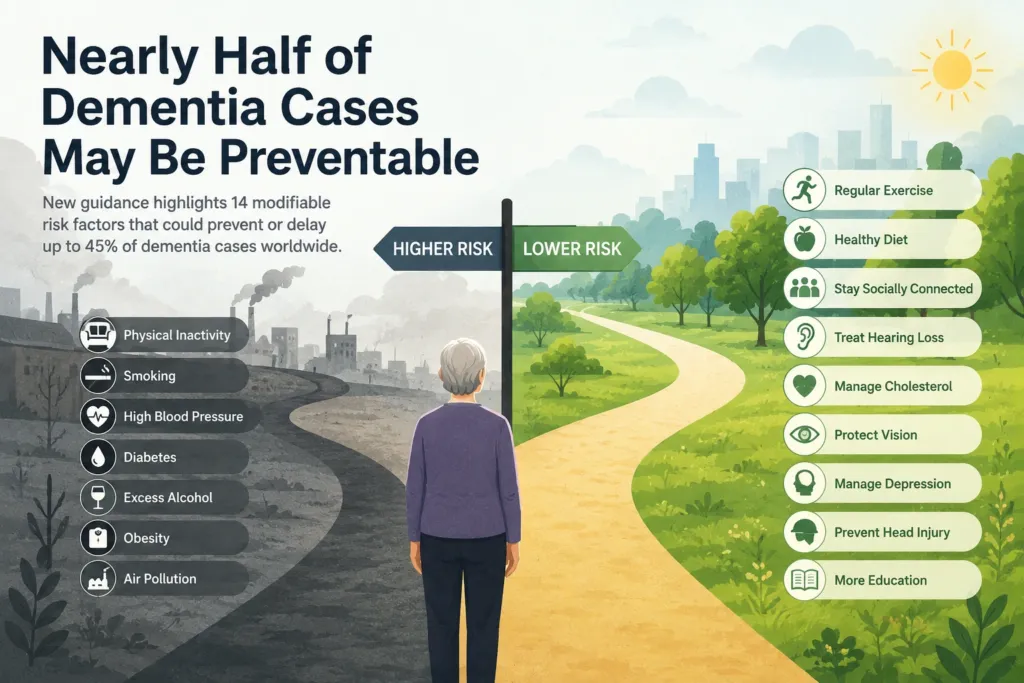
There’s a belief so common it barely gets questioned anymore: that dementia is simply what happens if you live long enough, a roll of the genetic dice nobody can do much about. It’s the same fatalism I’ve spent two decades pushing back against with heart disease and diabetes in the world’s longest-lived communities, and it turns out to be just as wrong here. New guidance released this month by the World Health Organization puts a hard number on it: up to 45% of dementia cases worldwide could be prevented or delayed. Not cured. Prevented, before they ever start.
Fourteen Factors, Nearly Half the Cases
That 45% figure isn’t new this month, exactly. It traces back to the Lancet Commission on dementia prevention, a standing group of dementia researchers who periodically update the full list of modifiable risk factors based on the latest evidence. Their most recent tally landed on 14 factors, two more than the previous update, adding uncorrected vision loss and high cholesterol to a list that already included physical inactivity, smoking, hearing loss, high blood pressure, diabetes, social isolation, excessive alcohol use, air pollution, low education, obesity, depression, and traumatic brain injury. What’s changed this month is that the WHO has folded that evidence into a freshly updated set of formal international guidelines, the kind meant to actually shape health policy rather than just sit in a journal.
Gill Livingston, the psychiatrist at University College London who has led the Lancet Commission’s work, has put it about as plainly as a researcher can: there is much that physicians can do to prevent dementia. That’s a genuinely different message than the one most people grew up with.
The Uncomfortable Part: Awareness Isn’t Enough
Here’s where I’d normally expect the story to end on an unambiguous high note, and where the real research this month insists on something more honest. A separate systematic review, Curtin University researchers found, published in The Lancet Healthy Longevity, looked at how well large-scale public health campaigns actually translate the 45% statistic into real behavior change. The answer, frustratingly, is not very well. Campaigns reach wide audiences and modestly bump up knowledge. They rarely move the needle on what people actually do differently in their daily lives.
Lead author Blossom Stephan named the underlying problem directly: a widespread belief that dementia is an unavoidable part of aging is still out there, stubborn and largely unmoved by awareness alone. Even people who do understand the risk factors run into the same wall everyone runs into trying to change a habit: time, cost, and motivation, the three things that separate knowing something from doing something about it. I’ve watched this exact gap play out in every longevity story I’ve ever reported. Information was never really the bottleneck. Making the healthy choice the easy choice is.
Muscle, Not Just Weight, Turns Out to Matter

A second Curtin-led study, this one covered by Medical Xpress and published in Clinical Nutrition, adds a genuinely useful, actionable nuance to the prevention conversation. Researchers followed nearly 500,000 adults over more than a decade and found that people with both low muscle strength and excess body fat, a combination researchers call sarcopenic obesity, faced meaningfully higher dementia risk. The twist is what happened to people who carried excess weight but kept their muscle strength up. Their dementia risk didn’t rise at all.
Study author Mario Siervo summed up the takeaway simply: 45 percent of dementia cases are linked to modifiable factors we can change, and this finding sharpens exactly which factor might matter more than people assume. Weight alone was never the villain doctors have sometimes made it out to be. Losing muscle while gaining fat is the combination actually driving risk, which reframes prevention advice away from the number on a scale and toward something more useful: staying strong. That finding lines up neatly with why exercise protects muscle as people age.
What This Actually Looks Like Day to Day
None of the 14 risk factors on this list require a research grant or a prescription to address. Physical activity, protecting hearing with a simple aid instead of letting it go untreated, managing blood pressure and blood sugar, staying socially connected, treating depression seriously, avoiding excess alcohol, even getting a pair of glasses for uncorrected vision loss, these are ordinary, achievable changes, the same category of daily habit that moved biological aging markers in older adults over just four weeks.
The honest caveat, echoed by every serious researcher in this space, is that risk factors don’t carry equal weight everywhere. What matters most in one country may barely register in another, which is exactly what risk factors vary by country found earlier this month. Prevention isn’t a single universal checklist. It’s a set of real, addressable levers that need to be pulled in the right order for the right population.
What I’ve learned reporting on the world’s longest-lived communities for twenty years applies just as directly here. Genes load the gun. Lifestyle, environment, and the community someone lives inside pull the trigger, or don’t. Dementia, it turns out, follows that same rule far more than most people have ever been told.