

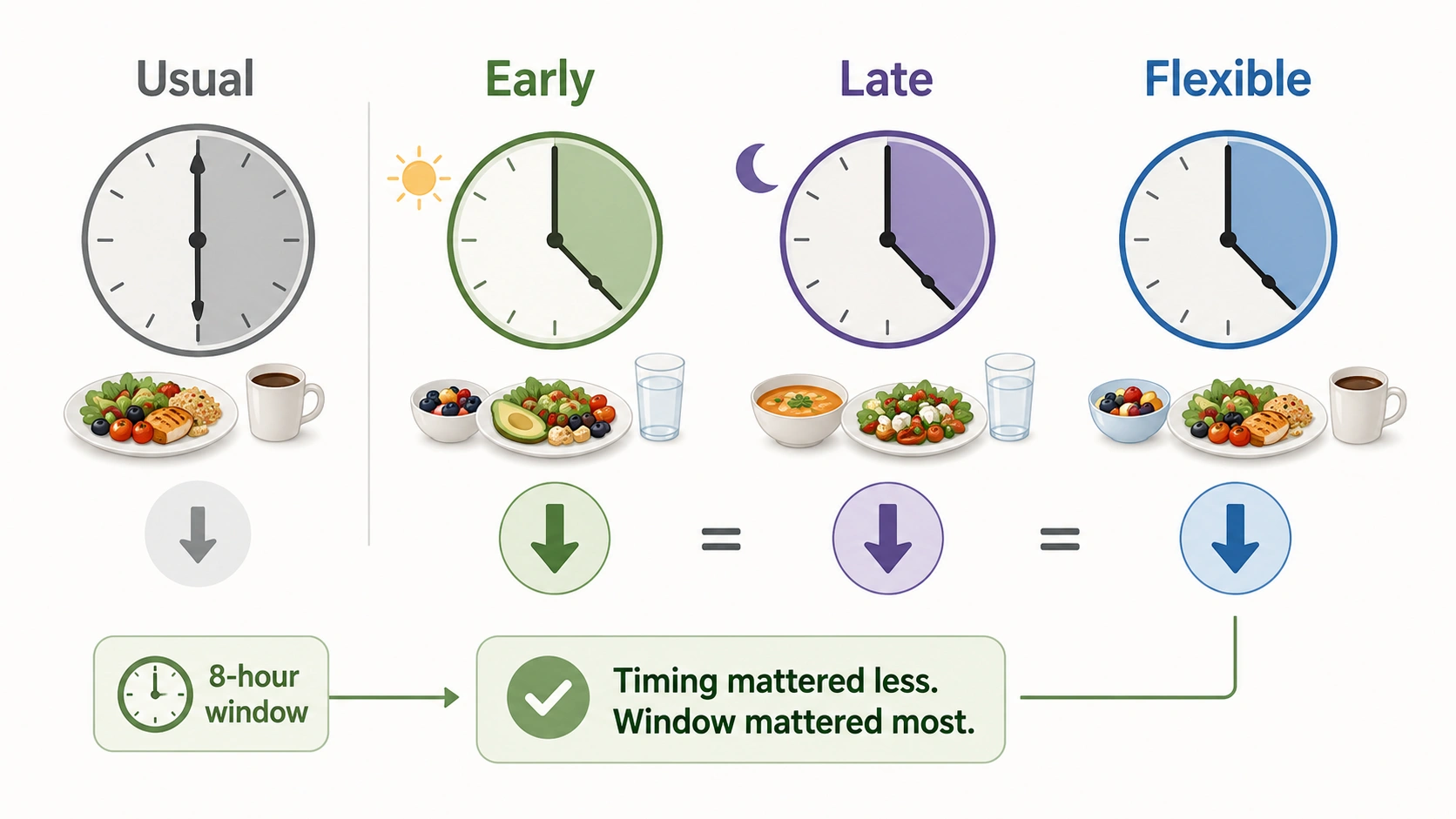
Somewhere in the last decade, intermittent fasting picked up a very specific piece of folklore: eat early, and your body’s circadian rhythm supposedly turns your metabolism into a fat-burning machine. Eat late, and you’re apparently sabotaging yourself no matter how little you actually consume. It’s a tidy story, it fits neatly into a wellness influencer’s caption, and according to the largest and longest study yet to actually test it, it’s mostly wrong.
The Study Built to Settle This
Researchers from the University of Granada, the Granada Institute for Biomedical Research, the Public University of Navarra, and CIBER ran a randomized controlled trial that did something most time-restricted eating studies hadn’t bothered to do: they directly compared different eating windows against each other, not just against unrestricted eating. Ninety-nine adults with overweight or obesity were split into four groups. One kept their usual habits, an eating window of 12 hours or more. The other three followed an 8-hour eating window, but scheduled differently, early in the day, late in the day, or whenever participants themselves chose. Everyone also received Mediterranean diet education alongside their assigned schedule.
The intervention itself ran 12 weeks. What makes this study genuinely useful, published in Clinical Nutrition, is that researchers then followed up a full year later, tracking who had actually kept the weight off rather than just measuring results the moment the structured program ended.
What Actually Happened to the Weight
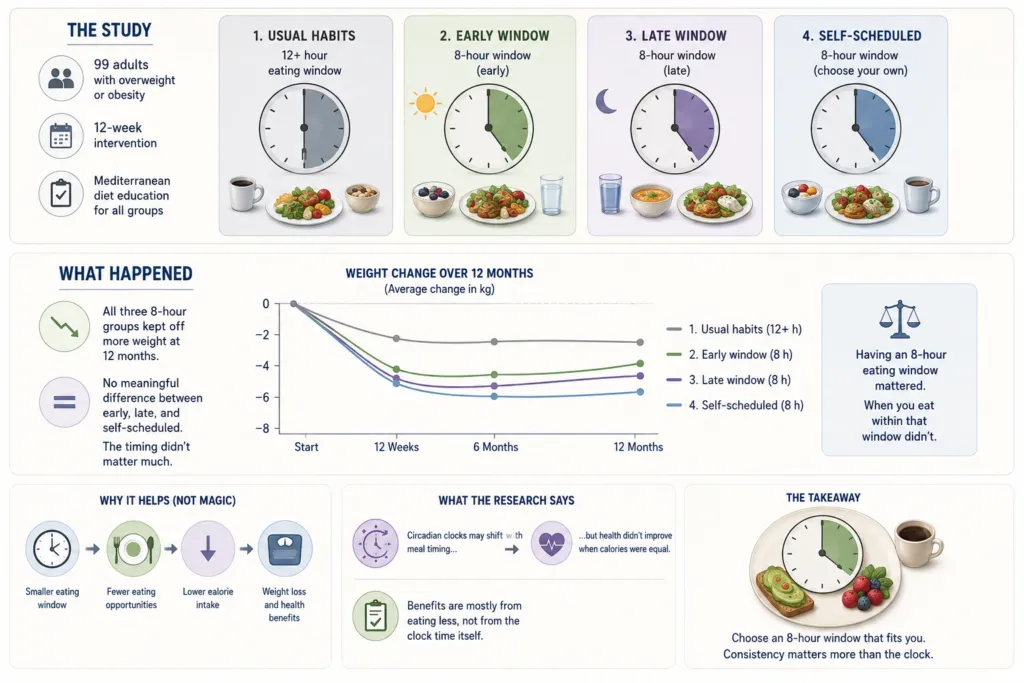
All three time-restricted groups maintained meaningfully more weight loss at 12 months than the usual-care group. That much lines up with what plenty of earlier research already suggested. The genuinely useful part of this study is what didn’t separate the three restricted groups from each other. Early eaters, late eaters, and self-scheduled eaters all did about equally well, a pattern also confirmed in the researchers’ own summary of the findings. The specific clock hours people chose to eat within their 8-hour window barely mattered. Having a window at all was the part doing the work.
So Why Does Restricting the Window Help at All?

This is where the circadian-rhythm mythology runs into a much less exciting explanation. A separate review of the broader time-restricted eating literature, Frontiers in Nutrition found, concluded that many of the benefits attributed to meal timing appear to be largely driven by something far less mystical: people simply eat less food overall when their eating window shrinks. Fewer hours available for eating tends to mean fewer opportunities for a second helping, a late-night snack, or an extra drink, not a hormonal switch flipping somewhere in the liver.
A separate trial makes the same point even more directly, in the least flattering way possible for the circadian-hype crowd. Researchers deliberately controlled for calories, keeping intake equal between a time-restricted group and a control group, an approach Science detailed, specifically to isolate the effect of timing from the effect of eating less. The time-restricted group’s circadian clocks did shift, measurably. Their cardiometabolic health did not meaningfully improve. Take away the calorie reduction, and most of the celebrated metabolic magic goes with it.
The Honest Version of What Works
None of this means time-restricted eating is useless, and it would be a mistake to read it that way. It means the mechanism behind it is a lot more mundane than the marketing suggests. An eating window is, functionally, a fairly effective behavioral trick for eating less without having to count a single calorie, not unlike findings from earlier trials comparing calorie restriction with and without a time component, which generally showed comparable results either way. There’s real, legitimate value in a strategy that makes portion control feel automatic rather than effortful. There just isn’t much evidence for a special metabolic bonus tied to which specific hours a person chooses.
What This Means for Someone Deciding When to Eat
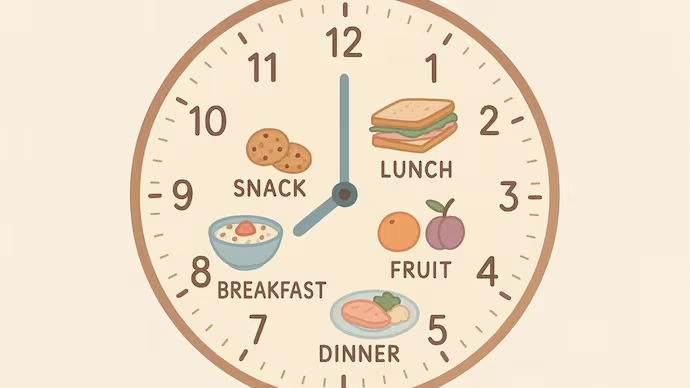
For a family helping an older relative manage weight or blood sugar, the actual takeaway is refreshingly low-stakes. Pick an 8-hour window that fits an existing routine, morning person or night owl, and don’t stress over hitting some supposedly optimal start time. That flexibility fits well alongside the broader pattern showing up across nutrition research lately, where modest, sustainable changes tend to outperform anything requiring rigid precision, and it echoes the same lesson driving prevention research generally, built from ordinary, repeatable habits rather than dramatic overhauls. The when, in the end, turned out to matter a lot less than simply having a when at all.