

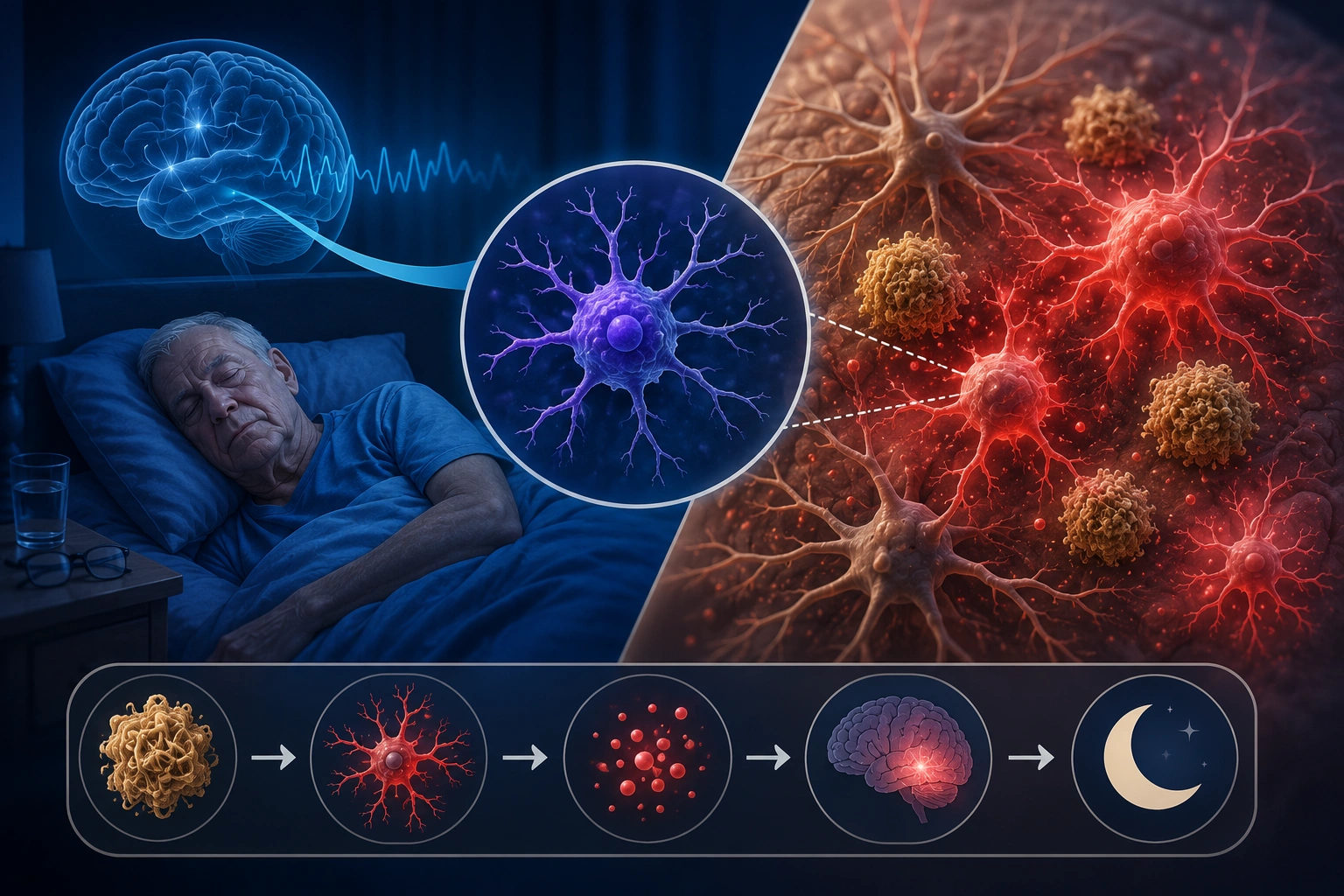
Imagine a small fire breaking out in one corner of a kitchen. With the right response, someone puts it out quickly and the damage stays contained. Now imagine the fire alarm instead floods the entire house, drowning the kitchen, the bedrooms, everything, in an overcorrection meant to protect but ending up doing more harm than the fire itself would have. That, according to University of Kentucky researchers, is essentially what happens inside a brain living with Alzheimer’s disease. The amyloid plaques are the fire. The brain’s own immune cells, microglia, are the sprinklers. And for decades, we assumed it was the fire itself keeping patients awake at night. It wasn’t.
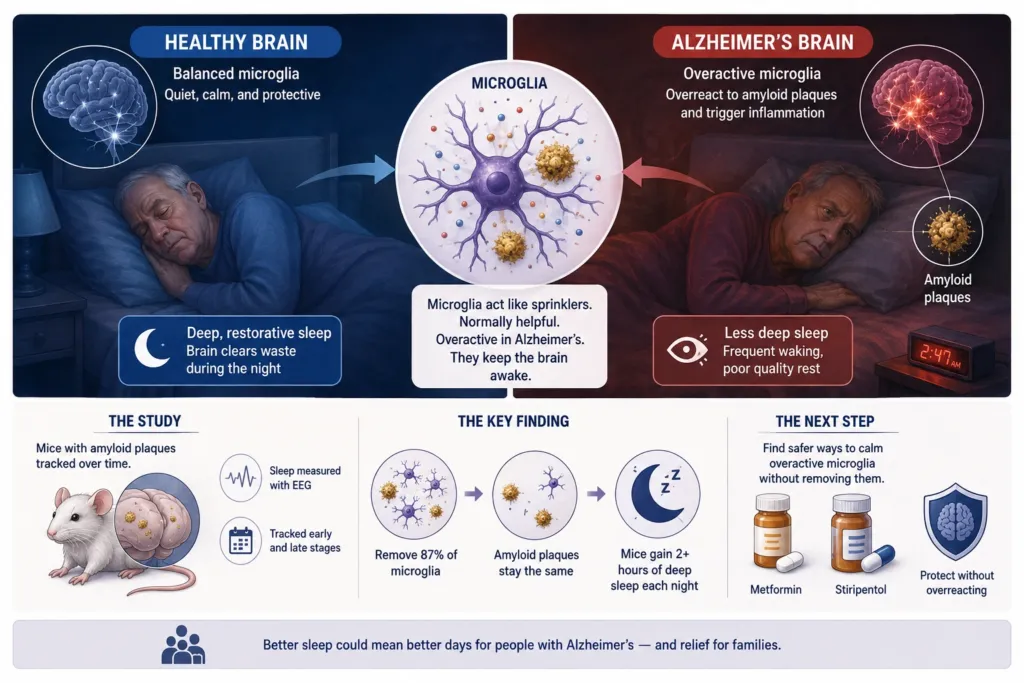
Researchers led by Shannon Macauley and first author Nicholas Constantino at the Sanders-Brown Center on Aging set out to test that old assumption directly. Using a mouse model bred to develop amyloid plaques, they tracked sleep with EEG and muscle recordings at two points, early on, when plaques first appear, and much later, once plaque levels had more than doubled. If plaques themselves were driving the sleep disruption, sleep should have gotten dramatically worse as plaque burden climbed. It didn’t. Sleep loss showed up early and largely stayed at that same level, a pattern ScienceDaily described as evidence pointing away from the plaques and toward something else entirely.
That something else turned out to be the microglia themselves. When these immune cells detect amyloid plaques, they mount an inflammatory response, the biological equivalent of sounding every alarm in the house at once. Researchers confirmed this by using a drug to temporarily deplete 87% of the microglia in these mice. The plaques stayed exactly where they were. Not one was cleared. And yet the mice gained more than two hours of deep, restorative NREM sleep a night, Medical Xpress reported, the same slow-wave sleep stage responsible for clearing metabolic waste from a healthy brain during a normal night’s rest. Macauley described the microglia’s behavior vividly, as News-Medical quoted her: it’s as though they’re partying all night, and keeping the brain awake.
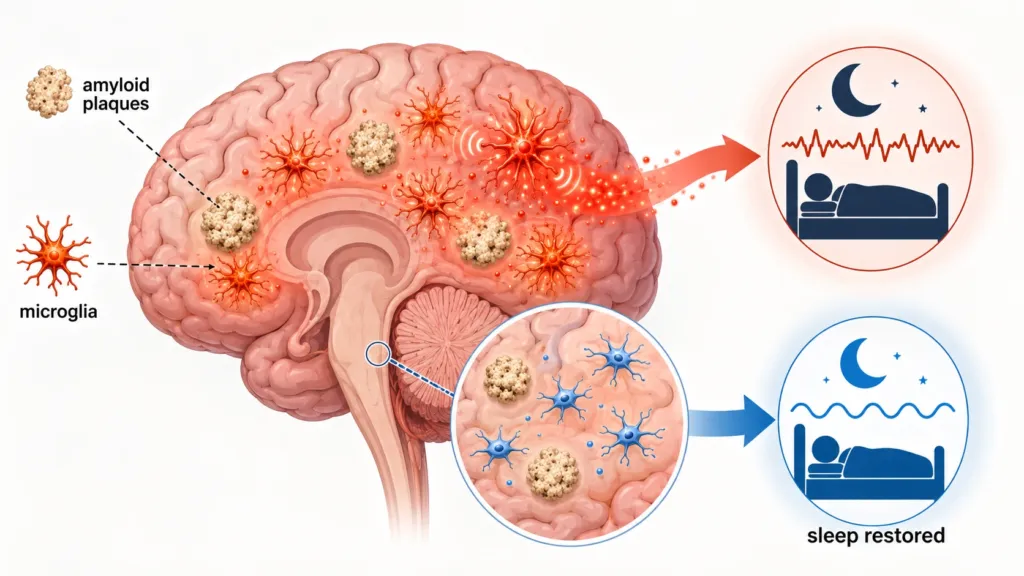
I want to be honest about why this finding matters as much as it does, beyond the elegance of the mechanism itself. Sleep disruption isn’t a minor inconvenience in Alzheimer’s disease. Between a quarter and nearly half of patients experience clinically significant sleep problems, fragmented rest, wandering at night, frequent waking, and it’s routinely cited as one of the leading reasons families reach the breaking point and decide residential care is the only remaining option. A treatment aimed specifically at restoring sleep, rather than only at clearing plaques, could change that calculus for a lot of exhausted families, an access problem already documented in how difficult in-home support has become to secure.
There’s an important safety caveat here that deserves equal weight to the excitement. The drug used to deplete microglia in this study was originally developed for cancer treatment and carries real liver toxicity risks in humans, serious enough to have suspended at least one clinical trial. It is not a treatment anyone should expect to see prescribed. Macauley’s lab is already working on a gentler approach, exploring whether existing, already-safe medications like the diabetes drug metformin or the antiseizure drug stiripentol might calm overactive microglia without eliminating them outright, Tech Times reported, the next phase of the research. Microglia still have real, essential jobs to do defending brain tissue. The goal isn’t silencing them. It’s teaching them when to stand down.
None of this changes anything for a family managing Alzheimer’s today. Current anti-amyloid treatments like lecanemab and donanemab target a genuinely different part of the disease process and should continue exactly as prescribed. What this research offers instead is a second front worth pursuing, one aimed directly at a symptom that shapes daily quality of life as much as memory loss does, and one that, unlike so much of Alzheimer’s research, might not require waiting for plaques to disappear before something actually gets better. Sleep, it turns out, may be salvageable on its own terms, precision over blanket suppression showing up again as the theme guiding this disease’s newest research.