

Fewer Medicare beneficiaries are getting home health care than in years past, and a new research brief from the Commonwealth Fund lays out why in more detail than most families ever see. The short version: it isn’t one problem. It’s several, stacking on top of each other.
Researchers interviewed more than 20 policy experts across traditional Medicare, Medicare Advantage, and aging and disability policy, along with home health agencies, providers, and advocates, between November 2025 and February 2026. Their conclusion was direct. Declining use of the traditional Medicare home health benefit reflects lower enrollment, yes, but it’s also being driven by payment policy, quality incentive structures, Medicare Advantage underpayment and narrow provider networks, how and where agencies choose to accept referrals, and a persistent shortage of workers to actually deliver the care.
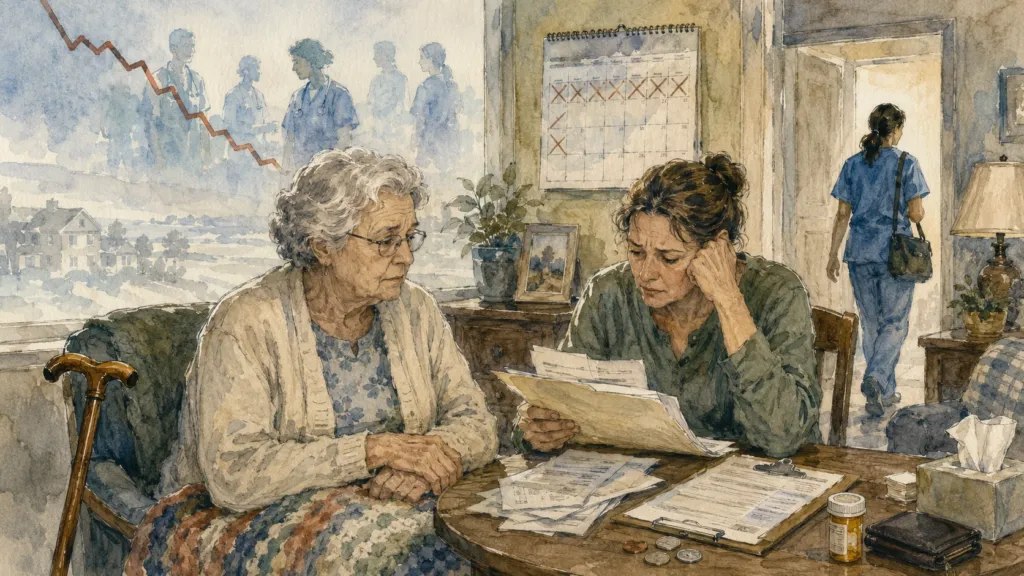
That workforce shortage turned out to be one of the sharpest findings in the brief. Home health agencies are struggling to recruit and keep staff, registered nurses especially, who can often find better pay and benefits working in a hospital instead. The scale of the problem is larger than most people probably assume. More than 25% of patients referred for home health care were turned away by providers simply because agencies didn’t have the staff to take them on. For families living in rural or underserved areas, or caring for a relative with complex or chronic needs, that shortage hits hardest, since those are exactly the cases agencies are least equipped to staff for.
Payment structure is compounding the problem rather than easing it. The current Medicare payment model tends to favor patients who need care for a short period of time over those with longer-term chronic conditions, the kind of ongoing support many older adults with dementia or multiple health conditions actually need. An agency has less financial incentive to take on the harder, longer cases, even though those are often the patients home-based care would help the most.
The money behind all of this has been unusually turbulent. CMS initially proposed a 6.4% cut to home health payments for 2026, a reduction that providers said would have been one of the steepest in recent memory and warned would push access even further out of reach. After months of pushback, the final rule softened that to a 1.3% net decrease, about $220 million less than 2025 levels. Providers still call the outcome damaging given how much operating costs have climbed. Since 2018, revenue per day for home health agencies has risen only about 13%, while inflation over that same stretch climbed roughly 27%, a gap that eats directly into an agency’s ability to pay competitive wages, which in turn feeds the staffing shortage driving all of this in the first place.

The longer-term trend line makes the scale of the shift even clearer. Home health aide visits, the hands-on help with bathing, dressing, and daily living tasks that many families rely on most, have declined by almost 94% over the past two decades. In 1998, the average Medicare beneficiary receiving home health care got 6.7 aide visits a month. By 2022, that number had fallen to less than half a visit a month. As a share of all home health services provided, aide visits dropped from 48% of total visits in 1997 to just 5% by 2021. Skilled nursing visits have followed a similar downward path.
Referral data from Homecare Homebase, a major home health software provider, shows the access gap in concrete numbers. Extrapolating from their client base, the industry likely saw around 11.9 million home health referrals in 2024. More than 4.2 million of those patients never actually made it into care. The share of referrals lost specifically to staffing shortages has more than doubled since before the pandemic, from about 3% of non-admissions in the years before COVID to roughly 6% now, after peaking near 9% in mid-2022.
None of these numbers exist in isolation from each other. Lower payment rates make it harder for agencies to compete for staff. Staffing shortages force agencies to turn away referrals, especially the more complex, time-intensive cases. Fewer beneficiaries getting home-based care means more pressure on nursing homes, hospitals, and unpaid family caregivers to fill the gap instead. For a family trying to arrange in-home support for an aging parent right now, this research offers a plain explanation for something many have likely already run into directly: longer waits, agencies with no open capacity, and a system that increasingly favors quick recoveries over the ongoing help chronic conditions actually require.