

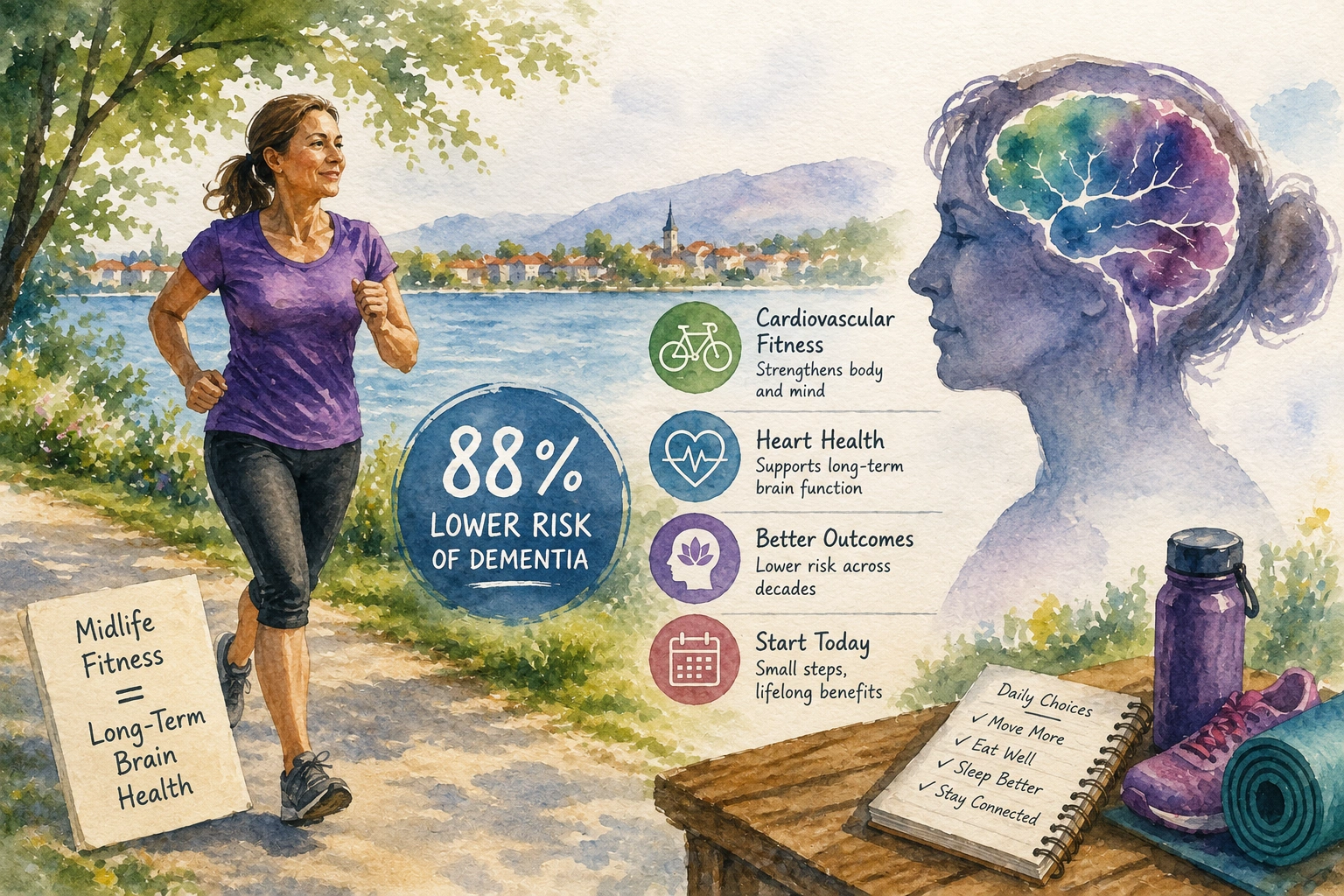
An 88% risk reduction is the kind of number that stops you mid-scroll, and it deserves exactly the scrutiny a number that dramatic should get before anyone rearranges their life around it. The figure comes from a real study, published in Neurology, and the underlying research is genuinely solid. It’s also from 2018, tracked a small group of Swedish women, and comes with caveats that rarely make it into the headline. Let’s actually look at what it found.
What the Study Actually Measured
Researchers at the University of Gothenburg, led by Helena Hörder, followed 191 women who were between 38 and 60 years old in 1968. Each woman rode a stationary bike to exhaustion, a maximal cardiovascular fitness test, and researchers sorted them into three groups based on peak performance: 40 women landed in the high fitness category, 92 in medium, and 59 in low. Then, remarkably, the researchers kept checking in. Dementia status was assessed six separate times, in 1974, 1980, 1992, 2000, 2005, and 2009, with diagnostic records tracked through 2012. That’s 44 years of follow-up on the same group of women, which is an unusually long runway for this kind of research.
The Actual Numbers Behind the Headline
Here’s where absolute numbers matter more than the relative one everyone quotes. Over those 44 years, 44 women total developed dementia. Among the highly fit women, 5% developed dementia. Among the medium fitness group, 25% did. Among the low fitness group, 32% did. The 88% figure comes from comparing high fitness to medium fitness specifically, expressed as a hazard ratio of 0.12, Harvard Health reported, meaning the risk in the high-fitness group was roughly one-eighth that of the medium group.

That’s a real, striking difference. It’s also built on just 40 women in the high-fitness group and a small number of total dementia cases, which is exactly why the confidence interval around that hazard ratio is wide, 0.03 to 0.54. The true effect could be considerably smaller than 88% and still be consistent with this data. Numbers built on small groups swing hard in either direction, and a single additional case in the high-fitness group would move that percentage substantially.
Association Is Not the Same as Proof
The researchers themselves were careful about this distinction, and it’s worth being just as careful repeating it. This is an observational study. Women weren’t randomly assigned to become fit or unfit; the fitness levels reflect whatever combination of genetics, health status, and life circumstances they already had in 1968. Fitness and physical activity aren’t interchangeable either, Healio’s coverage noted, since cardiovascular fitness has a real hereditary component that no amount of training fully overrides.
There’s a detail buried in the data that makes the causation question even messier. Among women whose cycling test was stopped early because of high blood pressure, chest pain, or other cardiovascular symptoms, 45% went on to develop dementia decades later. That’s not really a story about low motivation to exercise. It looks more like a story about underlying cardiovascular vulnerability that was already present in 1968, showing up on the bike test and showing up in the brain decades later, from a shared cause rather than a chain of causation running from fitness to brain health. A published critique in Neurology itself calculated that this study’s own numbers implied 8 out of 10 dementia cases could theoretically be prevented through fitness alone, a figure the critique called overoptimistic, outweighing every other factor combined that’s already known to influence dementia risk. When a single variable appears to outperform an entire field’s worth of established risk factors combined, that’s usually a sign the number needs more scrutiny, not less.
What’s Actually Worth Taking From This
None of this means cardiovascular fitness doesn’t matter for brain health. Other research, including the AAN’s own summary of this study, and separate work on how exercise supports aging muscle, points in a consistent direction: staying active in midlife is genuinely good for the body carrying the brain around. What this particular study can’t tell us is how much of its striking 88% figure reflects fitness itself doing protective work, versus fitness serving as an early marker for cardiovascular health that was already heading in a good or bad direction regardless of how often someone exercised.

The honest takeaway sits closer to the broader prevention case researchers have built around modifiable risk factors generally: physical activity belongs on that list, supported by plenty of other evidence, but this specific 44-year Swedish study is better read as one compelling, imperfect data point than as proof that fitness alone can cut dementia risk by nearly 90%. Disclosing that uncertainty isn’t a knock against the research. It’s what taking the research seriously actually looks like.