

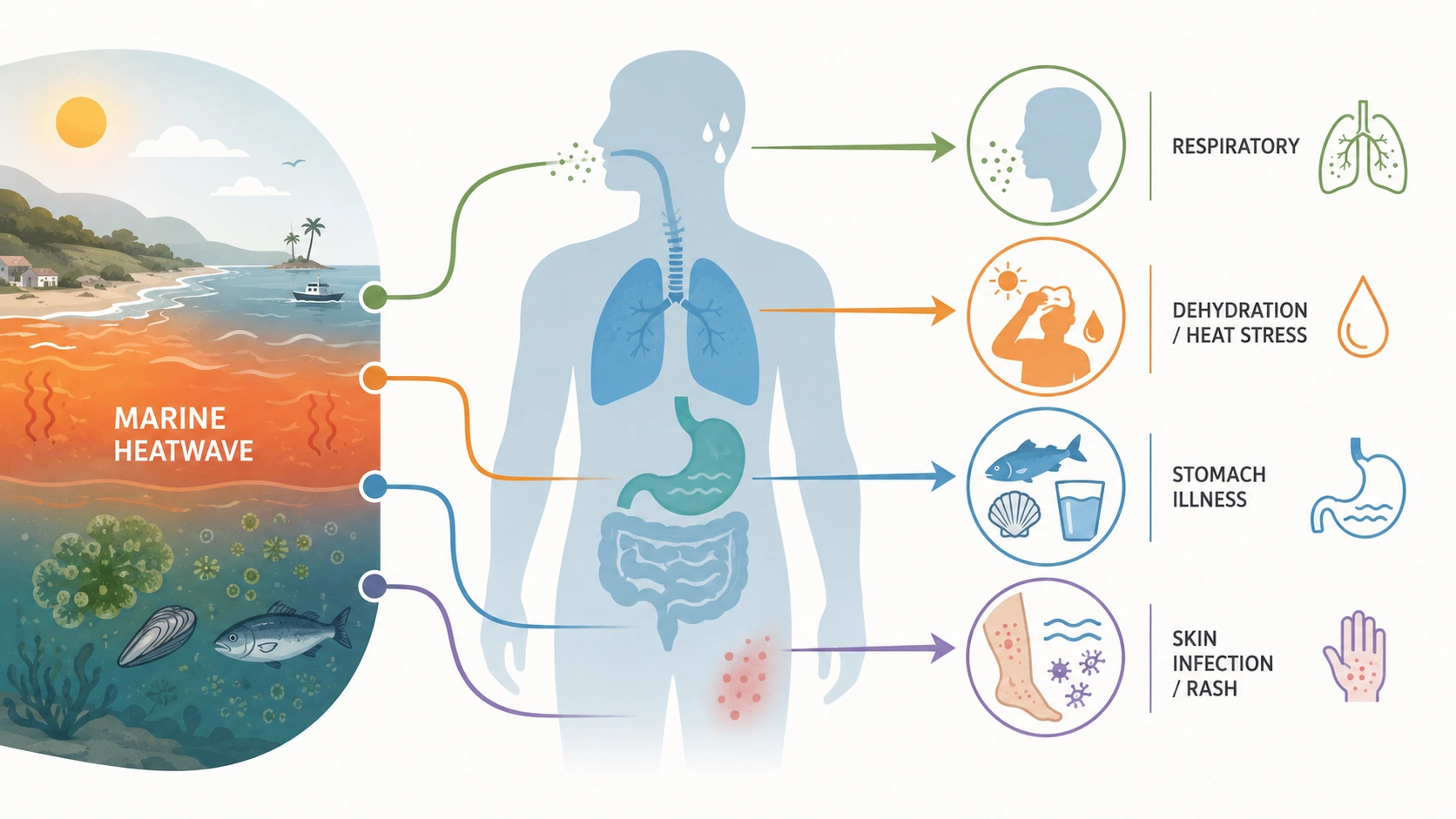
Hurricane Otis went from a tropical storm to a catastrophic Category 5 hurricane in roughly 24 hours in 2023, catching Mexican authorities and residents with almost no time to evacuate or prepare, and left a damage bill topping $15 billion. That kind of rapid intensification runs on a specific fuel: abnormally warm ocean water. A new paper in Nature Sustainability, led by researchers at Adelaide University and the University of Hong Kong, argues that connection, and several others like it, mean marine heatwaves deserve to be treated as a genuine public health concern, not just an ecological one.
The paper isn’t a single dataset or experiment. It’s a synthesis, pulling together evidence that’s mostly been studied in scattered pieces, and arguing those pieces actually form one connected chain running from the ocean surface straight into people’s physical and mental health. Storm intensification is the most visible link. Warmer seas act like fuel for tropical storms and typhoons, and the paper points to Typhoon Doksuri, which struck across Asia the same year as Otis and affected more than two million people, as another example of the same underlying pattern: hotter water, faster-strengthening storms, less warning time for the people in their path.
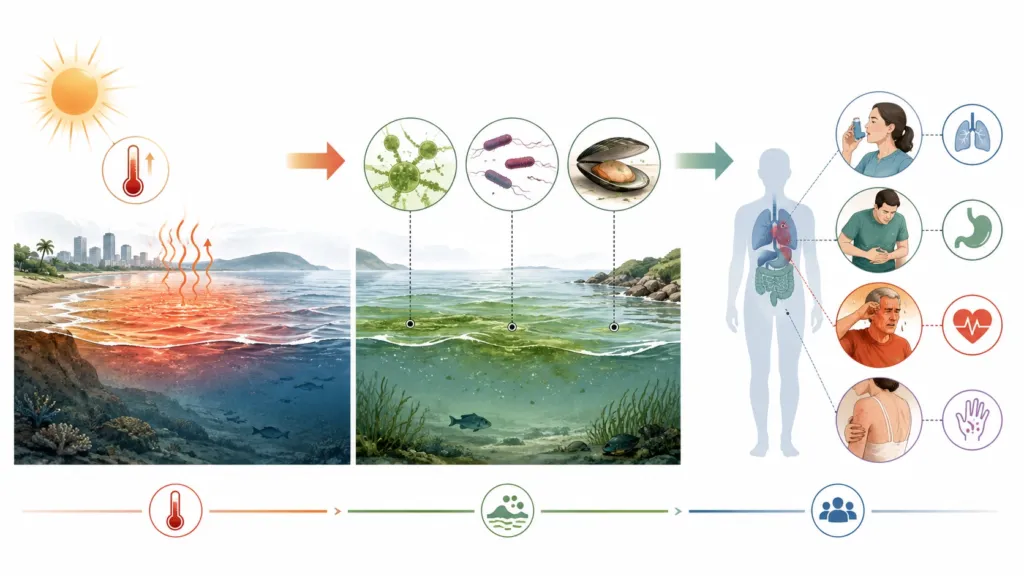
A quieter, less obvious link runs through the food supply. Warm ocean water encourages harmful algal blooms, growths of algae that can produce toxins dangerous enough to make seafood unsafe to eat. South Australia’s own recent algal bloom disaster, cited directly in the research, has already been tied to a range of health problems in the coastal communities living alongside it, beyond whatever damage it did to the fish themselves. Marine heatwaves also disrupt fisheries and aquaculture more broadly, which matters twice over in communities where seafood is both a primary food source and the economic backbone of local livelihoods.
Then there’s the piece least likely to show up in an environmental headline: mental health. Newswise’s coverage of the paper described researchers documenting real anxiety, grief, and depression in coastal communities whose identity and daily life are bound up with a marine environment that’s visibly degrading in front of them, a kind of grief that doesn’t have an obvious name yet but shows up reliably wherever researchers have gone looking for it.
The researchers’ actual policy argument is fairly specific, and it’s the part worth remembering longer than any individual statistic in the paper. Land-based heatwaves already trigger real public health infrastructure, heat warnings, cooling centers, targeted advisories for vulnerable groups. Marine heatwaves currently trigger almost none of that, despite reaching comparably far into human lives, according to the paper’s authors, who argue the gap exists mainly because attention has stayed fixed on coral reefs and fish stocks rather than the people who depend on both. Lead author Laura Falkenberg’s basic case is that ocean temperature should sit on the same public health radar as air temperature, a reframing that’s still genuinely new even to researchers who study climate and health closely.
None of the individual threats described here are unfamiliar on their own, stronger storms, unsafe seafood, economic disruption, and psychological strain from environmental loss have all been documented before in isolation. What’s new is treating them as one interconnected consequence of the same underlying cause, ocean temperature, and asking public health systems to start planning for marine heatwaves with the same seriousness already applied to heatwaves on land, particularly for coastal populations, older residents among them, who face the added burden of evacuation, disrupted food access, and health strain whenever the next hot ocean season builds into a storm that arrives faster than anyone expected.