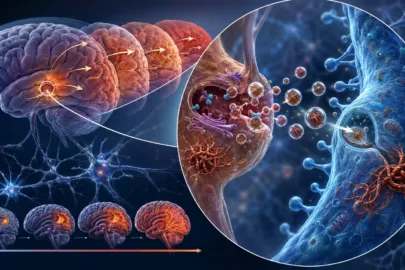

For decades, two proteins have played the villain in two of the most feared diagnoses in medicine. Tau gets blamed for Alzheimer’s. Alpha-synuclein gets blamed for Parkinson’s. Both misfold, both clump together into sticky tangles inside neurons, and both, once tangled, choke off the very cells they’re supposed to be helping. The standard response from researchers has been to try to stop them, block them, clear them out. A new study out of Baylor College of Medicine suggests that villain framing may have been missing something important all along. These proteins aren’t inherently bad. They’re just, apparently, bored.
Meet the Proteins Everyone Loves to Blame
Tau and alpha-synuclein have real, useful day jobs when things are working properly. Tau helps stabilize the internal scaffolding inside neurons. Alpha-synuclein helps manage the release of chemical messengers at the junctions between brain cells. Neither one showed up in the brain to cause trouble. The trouble starts when they misfold and begin sticking to each other, forming the toxic aggregates that pile up in the brains of people with Alzheimer’s and Parkinson’s disease, aggregates strongly linked to the memory loss, movement problems, and cognitive decline that define both illnesses.
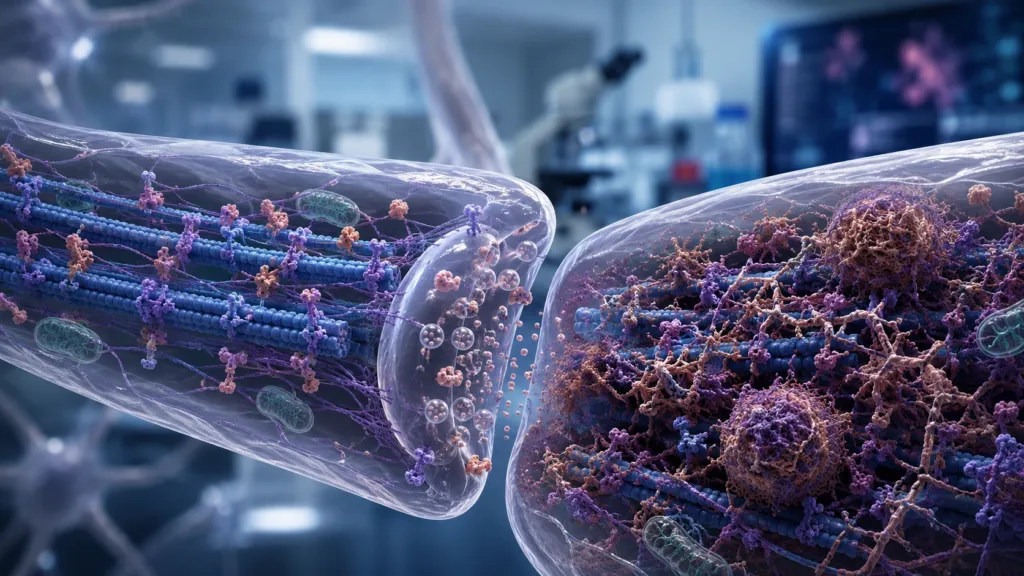
Most drug development in this space has treated the aggregation itself as the enemy, trying to block these proteins from forming clumps in the first place, or clear the clumps out once they’ve formed. It’s a reasonable strategy on paper. In practice, it runs into a stubborn problem: shutting a protein down entirely also shuts down whatever legitimate work it was supposed to be doing, and neurons don’t tend to thank you for that either.
The Railway Worker Behind the New Idea
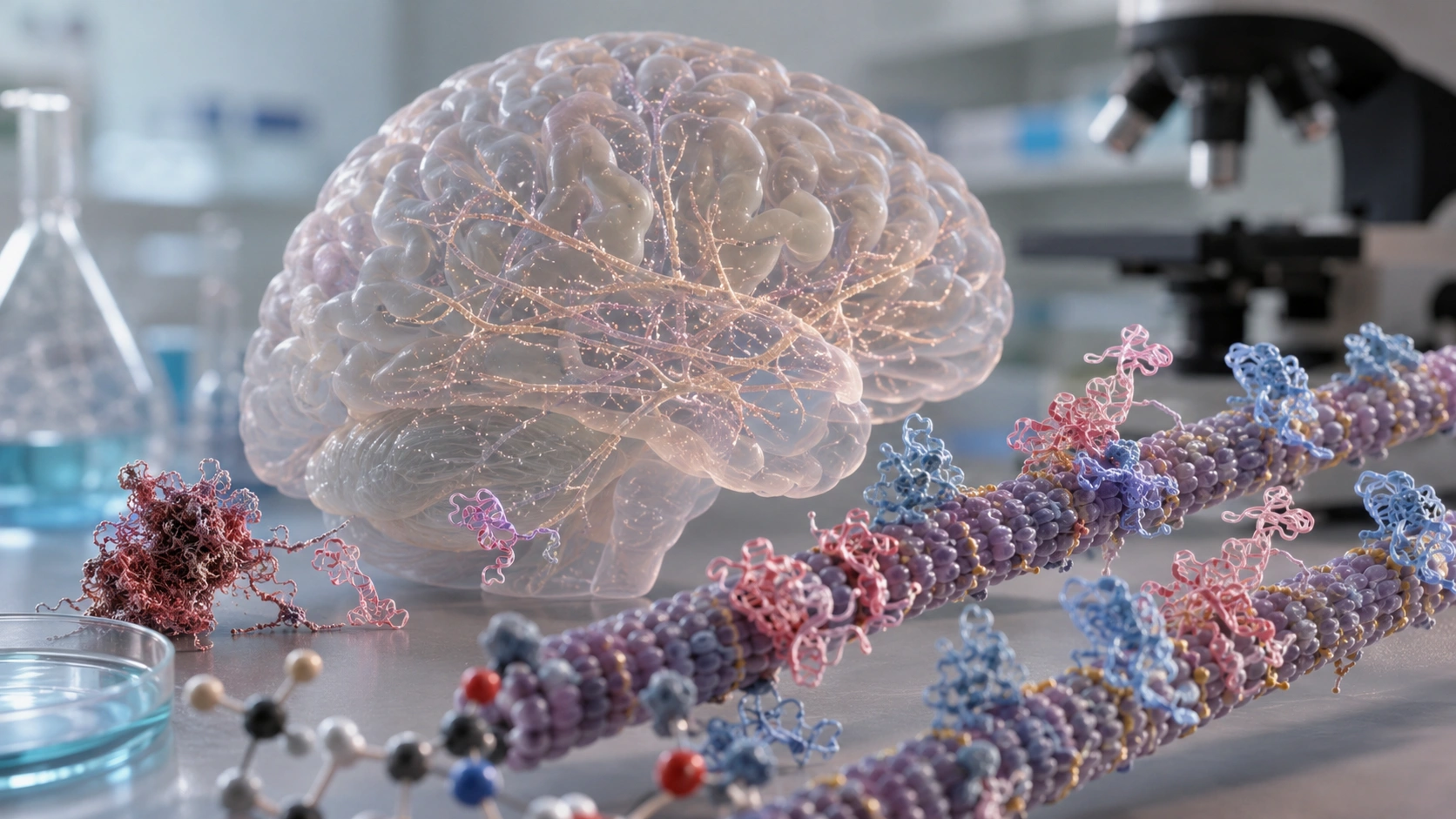
Enter tubulin, a protein with none of tau or alpha-synuclein’s bad reputation, mostly because tubulin has spent its career doing exactly what it’s supposed to do. Tubulin is the basic building block of microtubules, the internal scaffolding that functions almost like a rail network inside every neuron, moving nutrients, signals, and waste from one end of the cell to the other. Researchers led by Dr. Allan Chris M. Ferreon, with first author Dr. Lathan Lucas, found something nobody had connected before: tubulin doesn’t just coexist with tau and alpha-synuclein. It actively redirects them.
When tubulin is present in sufficient quantity, tau and alpha-synuclein appear to get pulled into a different kind of activity altogether, helping build and stabilize the very microtubule tracks tubulin is made of, instead of drifting off to misfold and tangle with each other. Give a restless protein a real task, in other words, and it seems less inclined to get into trouble. The findings were published in Nature Communications, and they describe something genuinely different from most Alzheimer’s and Parkinson’s research to date: an intervention aimed at the moment just before the toxic clumps ever form, rather than the cleanup crew arriving after the mess is already made.
Why Redirecting Beats Blocking
This distinction matters more than it might sound like at first. Ram Bishnoi, a psychiatry researcher not involved in the study, described the finding as offering a concrete, testable mechanism, a notably restrained way of saying that this gives future drug developers something specific to actually build toward, rather than another vague correlation to puzzle over.
- The appeal of a redirect-rather-than-block strategy is that it sidesteps the collateral damage problem baked into most current approaches.
- Instead of suppressing tau and alpha-synuclein and hoping the brain doesn’t miss their normal contributions too badly, this approach keeps them working, just working on something that doesn’t hurt anyone.
- It’s a more surgical idea than most of what’s currently in the Alzheimer’s and Parkinson’s drug pipeline, and one that treats these proteins less like intruders and more like employees who never got proper direction.
One Mechanism, Two Diseases
Here’s the detail that should make this finding travel further than a typical single-disease discovery. Because tubulin interacts with both tau and alpha-synuclein through what appears to be a shared mechanism, a therapy built around boosting or stabilizing the tubulin pool could, in principle, offer benefit against Alzheimer’s and Parkinson’s at the same time, two diseases that usually get studied, funded, and treated in almost entirely separate silos. There’s also a secondary implication worth noting: low tubulin levels in the brain might eventually serve as an early warning sign that toxic aggregation is becoming more likely, well before symptoms would show up, opening a possible new avenue for early detection alongside treatment.
How Far This Still Has to Go
None of this means there’s a tubulin pill coming to a pharmacy anytime soon, and it’s worth saying that plainly before anyone gets ahead of the science. Tubulin is a complex protein manufactured inside cells, not something a person can simply take as a supplement to boost their own supply. Turning this mechanism into an actual therapy will require finding a way to safely increase or stabilize tubulin availability in the brain specifically, a considerable engineering challenge sitting between this discovery and anything resembling a treatment.
What exists right now is something researchers in this field don’t get to say often: a real, specific, testable idea for how two of the most stubborn diseases in neurology might eventually be approached differently, not by fighting two familiar villains, but by finally giving them something better to do.