

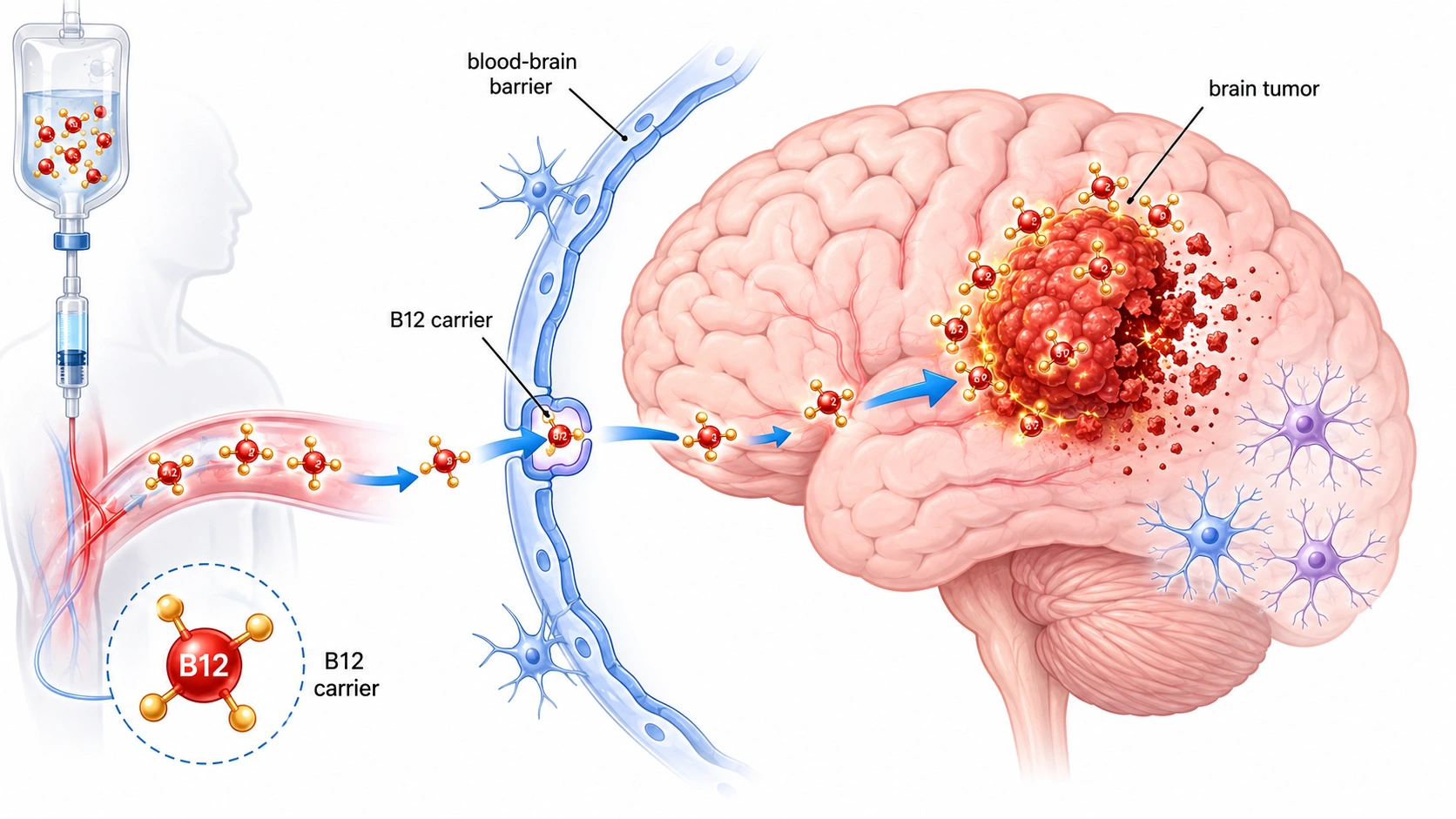
Glioblastoma is the cancer that has broken more researchers’ hearts than almost any other. Despite surgery, radiation, and chemotherapy, most patients survive less than 15 months, a number that has barely budged across decades of trying. A large part of the problem has never really been about killing the tumor cells themselves. It’s about reaching them at all. A new preclinical study, published in Oncoscience, offers a genuinely clever answer to that delivery problem, and I want to walk through both what it found and what it hasn’t shown yet, because those are very different things and this field has a bad habit of blurring them.
The compound is called nitrosylcobalamin, NO-Cbl for short, built by attaching a nitric oxide-releasing group onto vitamin B12. The idea behind it is elegant. The brain actively imports vitamin B12 through its own dedicated transport receptors, a normal, everyday biological process that has nothing to do with cancer. Researchers led by Joseph Bauer at the Cleveland Clinic’s Taussig Cancer Center essentially disguised a cancer-fighting molecule as cargo the brain already knows how to let in. Once inside, tumors accumulate the compound at higher concentrations than the healthy tissue around them, because tumor cells have the kind of elevated, hungry metabolism that pulls in more of almost everything, a detail confirmed through imaging of nitrate and cobalamin-related markers in the tumor tissue itself.
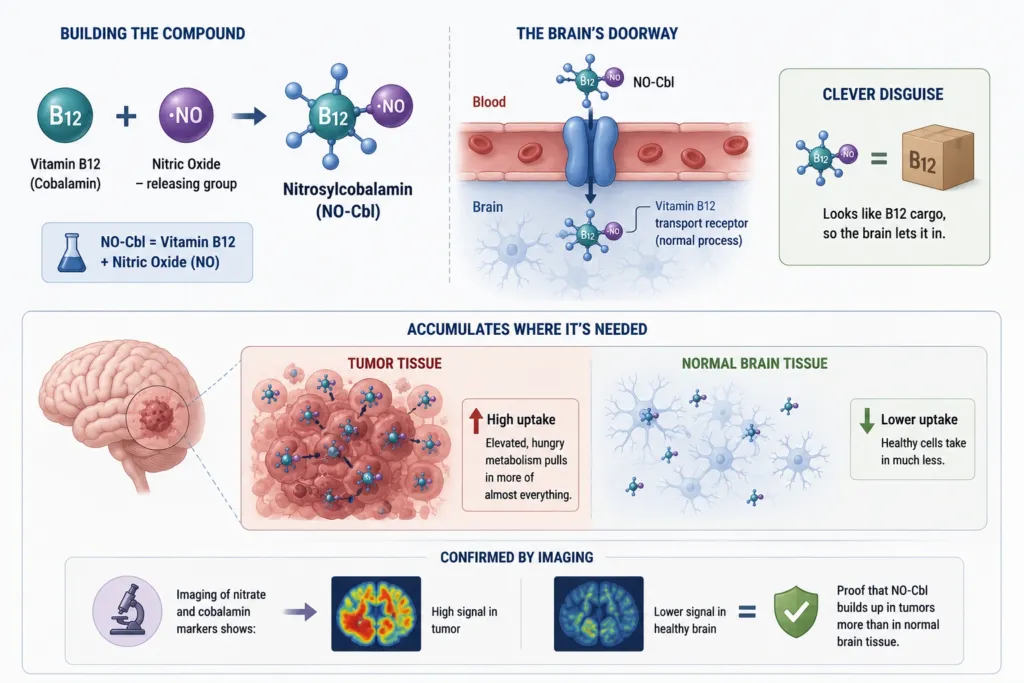
In rats carrying glioblastoma tumors, the compound crossed the blood-brain barrier after a simple systemic injection, not a direct injection into the brain, and stayed active inside the tumor for at least 24 hours. When combined with existing treatments, TRAIL and temozolomide, the standard chemotherapy drug already used against this cancer, the compound enhanced their effects, work described in detail across a broad screening panel of human tumor cell lines.
Now, here’s where I want to slow down, because this is exactly the point where headlines tend to run ahead of the science. When researchers tested NO-Cbl against the NCI-60 panel, a standard battery of dozens of human cancer cell lines, the central nervous system tumor lines showed only moderate sensitivity, not the strongest response in the panel. That’s not a disqualifying detail, but it’s one worth sitting with rather than skipping past. And every result described here, News-Medical reported plainly, comes from rats and cell lines, not from a single human patient. The researchers themselves have said further work is needed to confirm these results, refine dosing, and test the compound in additional brain tumor models before anyone could responsibly move toward a human trial.
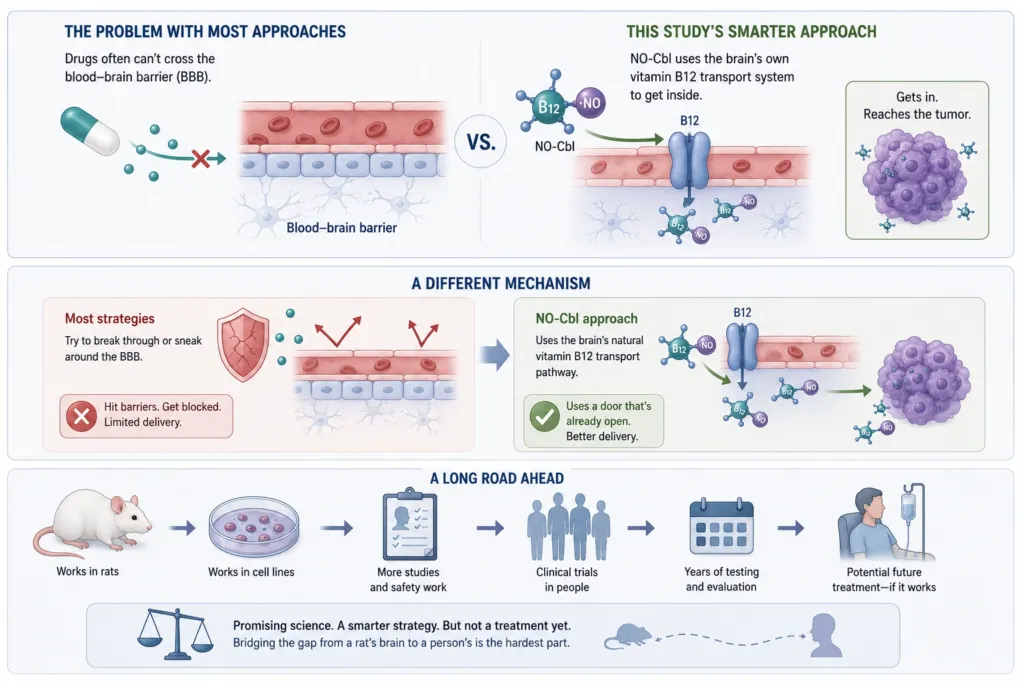
I’ve spent a career watching mouse and rat models promise things that didn’t survive contact with actual patients, and I say that as someone who has lost family to this disease, not as a critic sitting comfortably on the sidelines. That history doesn’t mean this finding isn’t worth real attention. The mechanism here is genuinely different from most of what’s been tried against glioblastoma, as one detailed account of the study explained, using the brain’s own transport system rather than fighting against the barrier that keeps it out. That’s a smarter starting point than most delivery strategies I’ve read about. It just isn’t a treatment yet, and it won’t be for years, if it ever clears the considerable distance between a rat’s brain and a person’s.
For a family facing a glioblastoma diagnosis right now, the honest thing to say is that this research offers a real, interesting direction, not a reason to expect anything different at the next oncology appointment. It’s not pessimism. It’s respect for how many findings like this one, promising, elegant, well-designed, have quietly disappeared on the long road toward human trials, not unlike other targeted compounds still working to prove themselves. The blood-brain barrier itself remains one of the hardest obstacles in all of neuro-oncology, and a compound that can genuinely slip past it deserves to be watched closely. It just doesn’t deserve to be oversold before it’s earned that.