
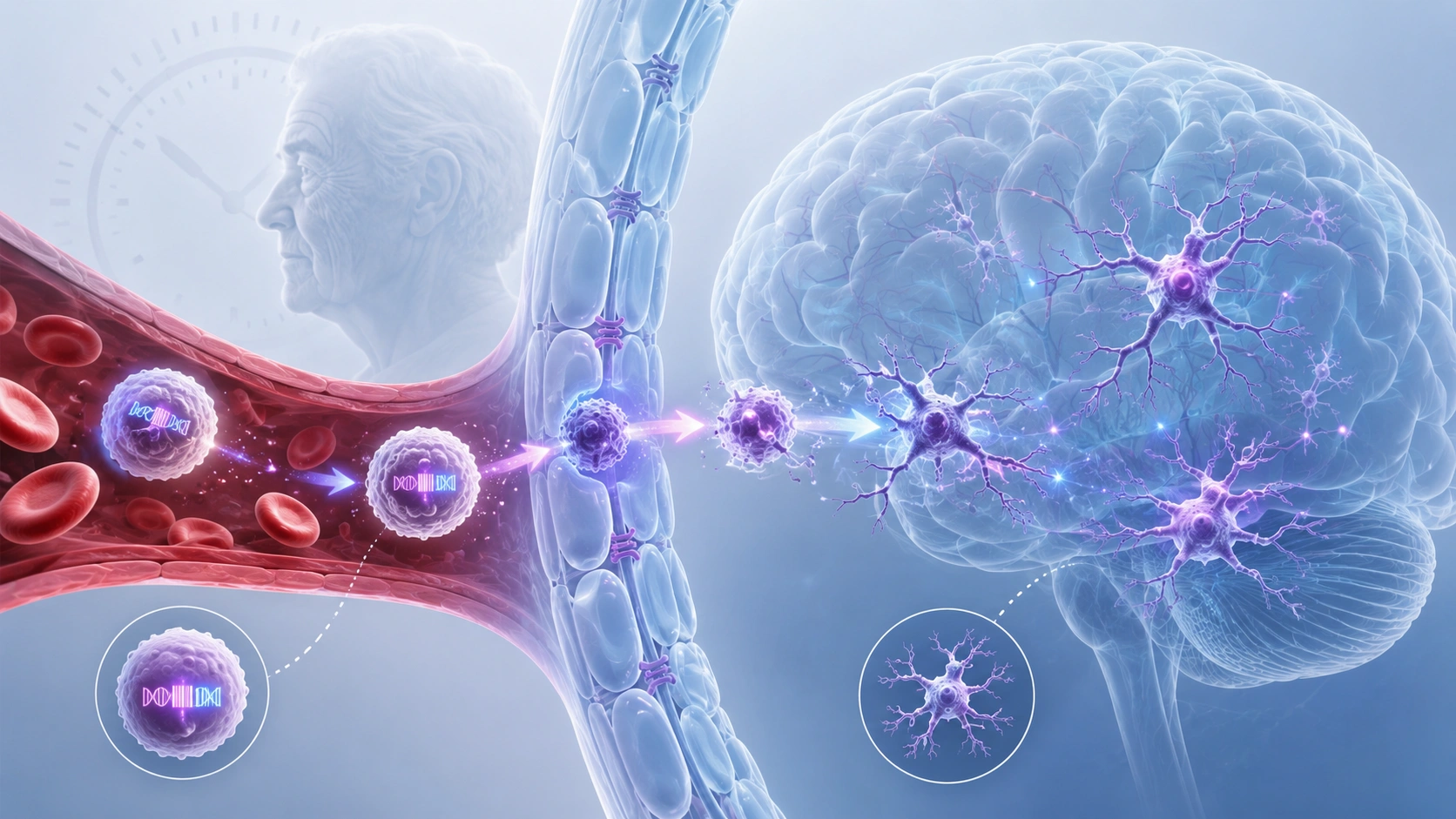
Neuroscience has operated for decades on a specific assumption: the brain runs its own immune defense, entirely separate from the immune system managing the rest of the body. Microglia, the brain’s resident immune cells, were thought to be a closed population, established early in development and left largely alone behind the blood-brain barrier for the rest of a person’s life. A team at Stanford Medicine, publishing in Nature, has found that assumption doesn’t hold up, at least not in humans.
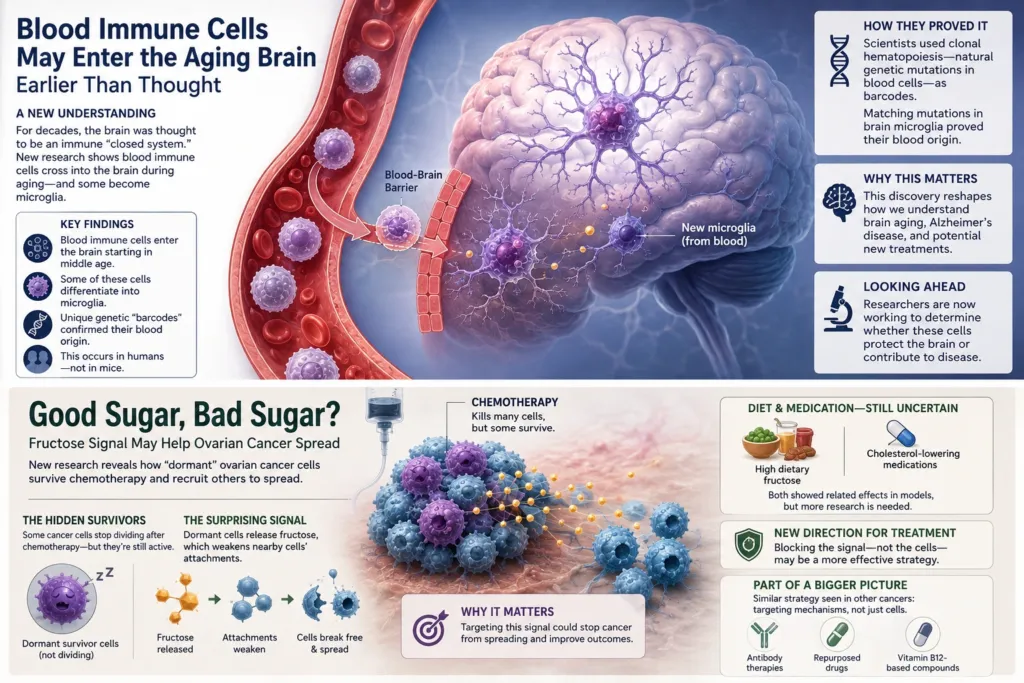
“We usually think of the brain as a closed system,” said Julia Belk, the study’s first author and a postdoctoral scholar in pathology. What she and senior author Siddhartha Jaiswal found instead is that a substantial number of immune cells originating in the blood cross into the brain during aging, and some of them go on to become functioning microglia themselves. The influx starts as early as middle age, not in the final stretch of life most people associate with cognitive decline.
How a Genetic Fingerprint Solved a Decades-Old Mystery
Proving that a cell in the brain actually came from the blood is a genuinely hard technical problem, since a microglia cell doesn’t come with a passport showing where it was born. The Stanford team found a workaround in something called clonal hematopoiesis, a process where blood-forming stem cells in bone marrow pick up small genetic mutations over a lifetime, mutations that then get passed down to every cell those stem cells produce. Each person ends up with a unique, traceable set of mutation signatures scattered across their blood and immune cells, something close to a natural barcode.
Researchers compared blood samples against postmortem brain tissue from the same individuals, pulled from the Stanford Rapid Autopsy Center and the University of Washington’s Alzheimer’s Disease Sequencing Project, looking at people with and without Alzheimer’s disease. Where a mutation signature showed up in both a person’s blood and their brain’s microglia, that overlap served as direct evidence the cell had migrated from one to the other. The match showed up again and again.
Why Mice Could Never Have Shown Scientists This
Here’s a detail that matters more than it might first appear. This same migration doesn’t happen in mice or non-human primates, according to the research team, a distinction Stanford’s own reporting on the work treated as central to why this went unnoticed for so long. Decades of neuroscience built on mouse models simply couldn’t have revealed a process that appears to be uniquely human. It’s a reminder that some of the most basic assumptions in a field can survive years of animal research untouched, waiting on a study built around actual human tissue to finally catch them.
The NIH’s own summary of the work, funded in part through its research programs, noted that this clonal hematopoiesis technique gave researchers something rare: a way to trace cell ancestry directly in human tissue rather than relying on animal proxies or indirect markers.
What This Means for a Brain Already Under Study
The Stanford group didn’t stumble into this question by accident. Coverage of the study’s origins noted the team began investigating peripheral immune cells specifically because of an apparent link to Alzheimer’s resilience, the same kind of resilience researchers elsewhere have traced to differences in neuron survival and neurogenesis rather than genetics alone. Whether this blood-to-brain migration turns out to be protective, reinforcing a brain’s defenses as it ages, or a contributor to the neuroinflammation seen in diseases like Alzheimer’s, isn’t yet resolved. Both possibilities are now active questions instead of unexamined assumptions.
That uncertainty cuts in an interesting direction for a field already circling similar territory. Researchers studying why sleep breaks down in Alzheimer’s disease have already traced real damage back to overactive microglia specifically, and this new work raises an obvious follow-up: how many of those overactive cells were actually born in the brain at all, versus recruited in from the blood partway through life. It also adds a fresh angle to research on people who reach old age with exceptional memory, where genetics alone has already been ruled out as the deciding factor, and to work explaining why some brains tolerate Alzheimer’s pathology far better than others. A blood-to-brain immune pathway nobody previously accounted for is now sitting inside every one of those open questions, which is exactly the kind of foundational shift that tends to open new treatment avenues once researchers figure out which side of the ledger it actually belongs on.