


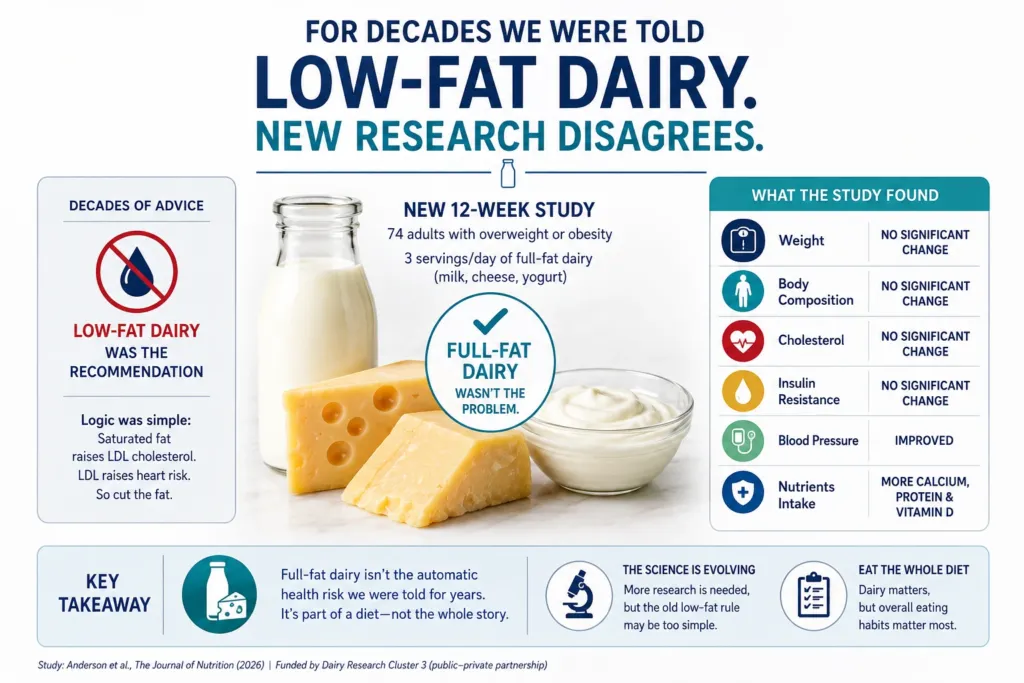
Seventy-four adults with overweight or obesity spent twelve weeks eating three servings of full-fat dairy a day, full-fat milk, cheese, yogurt, the kind official guidance has spent decades steering people away from. Their weight didn’t meaningfully change. Neither did their body composition, their cholesterol, or their insulin resistance, compared with adults eating less dairy or none at all. Blood pressure actually improved, and they took in more calcium, protein, and vitamin D along the way. The study, published in The Journal of Nutrition by University of Toronto researcher Harvey Anderson, is a fairly direct challenge to a piece of dietary advice most adults have heard their entire lives.
The logic behind the low-fat recommendation always seemed sound enough on paper. Saturated fat raises LDL cholesterol, LDL cholesterol raises cardiovascular risk, so cutting the fat out of dairy should cut the risk too. Anderson’s point, echoed across multiple outlets covering the study, is that human research testing this chain of logic directly hasn’t consistently backed it up. The evidence from human research has not always matched those concerns, he said, and he’s not alone in reaching that conclusion; other researchers at the same institution have reported similar neutral or protective associations with dairy consumption in recent years.
The explanation researchers are leaning on is called the dairy matrix hypothesis, the idea that a food’s actual structure, how its fat, protein, and micronutrients are physically packaged together, shapes how the body digests and absorbs it, in ways that treating saturated fat as an isolated villain misses entirely. A gram of saturated fat inside a glass of whole milk, in other words, may not behave identically to a gram of saturated fat sitting somewhere else, an idea Al Jazeera’s coverage walked through in some detail, tracing how the basic nutritional logic that shaped decades of guidance may have been too simple from the start.
Worth knowing plainly: this study was funded through Dairy Research Cluster 3, a joint government and dairy-industry research initiative. That doesn’t make the findings wrong, and the methodology, a randomized trial with defined dietary groups, is a real step up from the observational data a lot of nutrition headlines lean on. It does mean the funding source is worth knowing before treating this as neutral, disinterested science, the same way any industry-backed research deserves a slightly harder look regardless of which industry is paying for it.
The sample size is modest too, 74 people, and everyone studied already had overweight or obesity, which limits how confidently the results generalize to other populations. Major dietary guidelines in Canada, the United States, and elsewhere still recommend low-fat dairy, and one 12-week trial, however well designed, isn’t enough on its own to rewrite official advice that took decades to establish. Coverage from Medindia framed it accurately: the findings complicate a settled-seeming picture rather than replace it outright.
What this adds up to for someone actually standing in a grocery aisle is less dramatic than the headline but more useful. Full-fat dairy isn’t the automatic health risk decades of low-fat advice implied, and swapping it back in isn’t likely to undo anyone’s cardiovascular health on its own. It also isn’t a green light to abandon every other piece of dietary guidance built around similarly modest, well-tested changes that have held up across more than one twelve-week trial. Dairy fat, in the end, looks less like a villain and less like a hero than either version of the story suggested, somewhere closer to the ordinary that most nutrition science actually lives.