
A drug that’s been sitting in pharmacies for decades, prescribed to protect aging bones from osteoporosis, just showed up somewhere nobody expected: blocking the mineral buildup that hardens and eventually fuses spinal discs. That’s the headline coming out of a new study from the University of Edinburgh and University of Bristol, published in Communications Biology. What’s less widely reported alongside it is a separate, earlier study suggesting a very similar class of drug might make a related problem worse, not better, which is worth knowing before anyone gets too excited about a pharmacy shelf already having the answer.
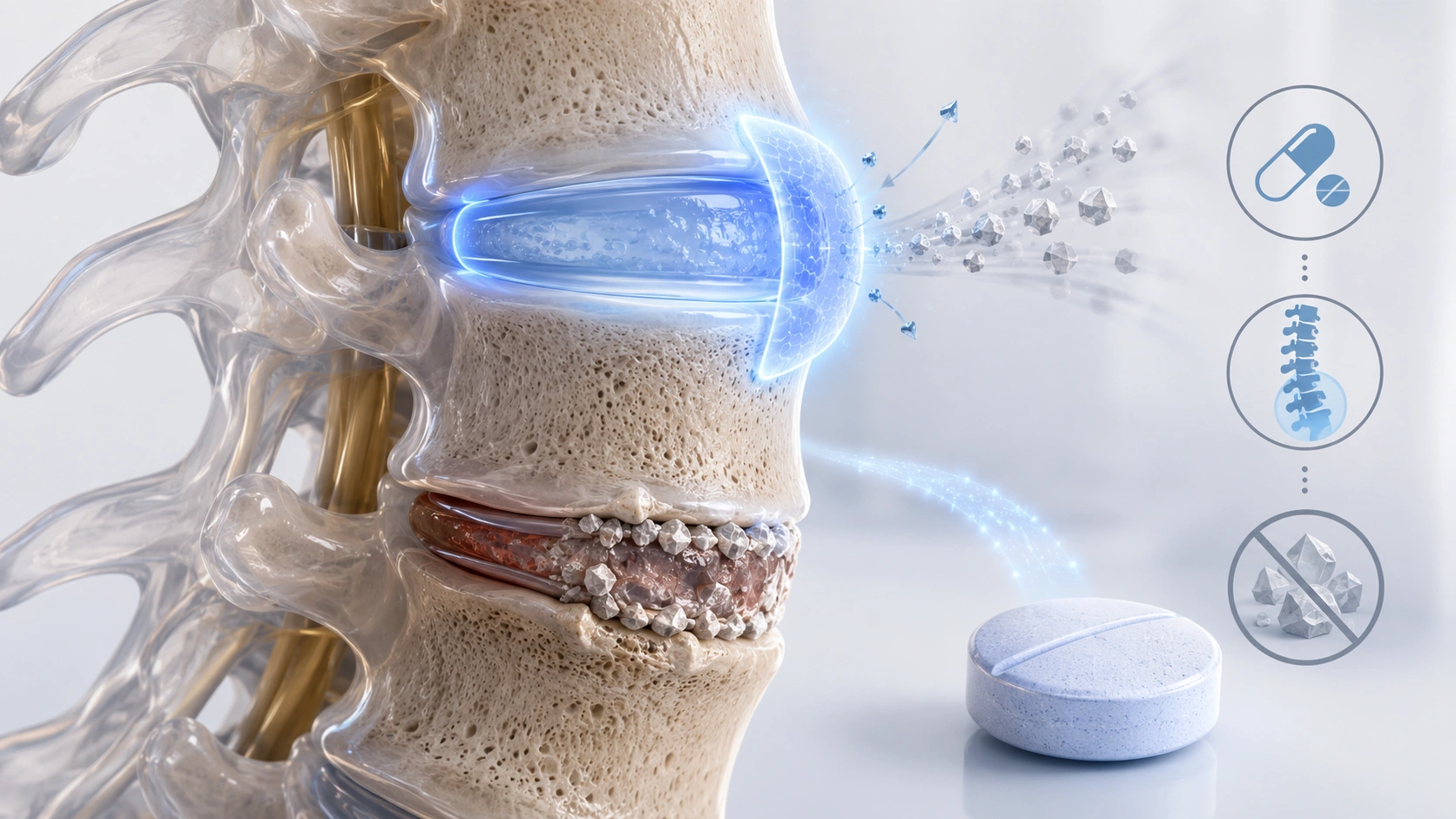
Researchers led by Erika Kague bred zebrafish without a working copy of a gene for collagen IX, a protein that helps bind the fibers giving spinal discs their structure. Discs cushion the vertebrae and depend on that fiber network to absorb load while staying flexible. Without functioning collagen IX, the fish developed a chain reaction: the fiber scaffold broke down early, minerals built up where they shouldn’t, and the spine eventually hardened and fused, a pattern that closely resembles intervertebral disc degeneration in humans, one of the most common causes of chronic back pain and a condition with no medication currently able to stop or reverse it. Surgery remains the only long-term option, which is exactly why any credible new drug target draws attention.
The team tested three separate ways of interrupting the damage, and all three worked to some degree. A bisphosphonate, the same bone-protecting drug class already approved and widely prescribed for osteoporosis, blocked the mineral buildup outright. Simply restricting how much the fish ate reduced spinal fusion, a dietary lever not unlike what a modest four-week change was enough to shift in an entirely different aging study. So did drugs that dampen fat metabolism. Kague framed the stakes plainly: for decades, surgery has been the only real answer for disc disease, and this is the first time a specific biological pathway has pointed toward something else.
Here’s the part worth sitting with before treating this as a settled win. A separate zebrafish study, published earlier in the journal Bone Research, found something that complicates the bisphosphonate story specifically. That work looked at a different gene, one controlling an enzyme called cathepsin K, and found that reducing its function actually accelerated disc degeneration rather than slowing it. Cathepsin K inhibitors work through the same general antiresorptive mechanism bisphosphonates do, blocking the body’s natural bone breakdown process. Those earlier researchers went so far as to suggest that antiresorptive drugs used over long periods might drive disc disease forward instead of holding it back, close to the opposite of what this new study found. The two results don’t technically contradict each other, since they tested different interventions in different genetic models, but together they say something honest: the relationship between bone-targeting drugs and spinal disc health isn’t simple, and nobody should assume it’s settled based on one favorable result.
There’s also the matter of what bisphosphonates already cost the body in exchange for protecting bone. The drugs carry known risks, including osteonecrosis of the jaw and atypical femoral fractures, risks doctors currently accept because preventing fractures in osteoporosis outweighs them. Whether that same trade-off holds for a completely different patient population, people with disc degeneration who may not have osteoporosis at all, hasn’t been worked out, and no human trial has tested a bisphosphonate for this specific use. Every result in this study came from zebrafish, not people, and that distance matters.
None of that erases what the study actually accomplished. Identifying phosphate handling and fat metabolism as real, targetable pathways behind disc hardening gives researchers somewhere new to aim, something the research team itself called a genuinely exciting foothold after decades with nothing beyond surgery to offer. For a condition this common and this costly, a documented new drug target is real progress. It’s just progress that, as one careful account of the findings noted, deserves to be reported with less enthusiasm than the underlying fish data can currently support, and families managing an older relative’s back pain should treat this as a promising early lead, not a treatment anyone can ask a doctor for yet.