
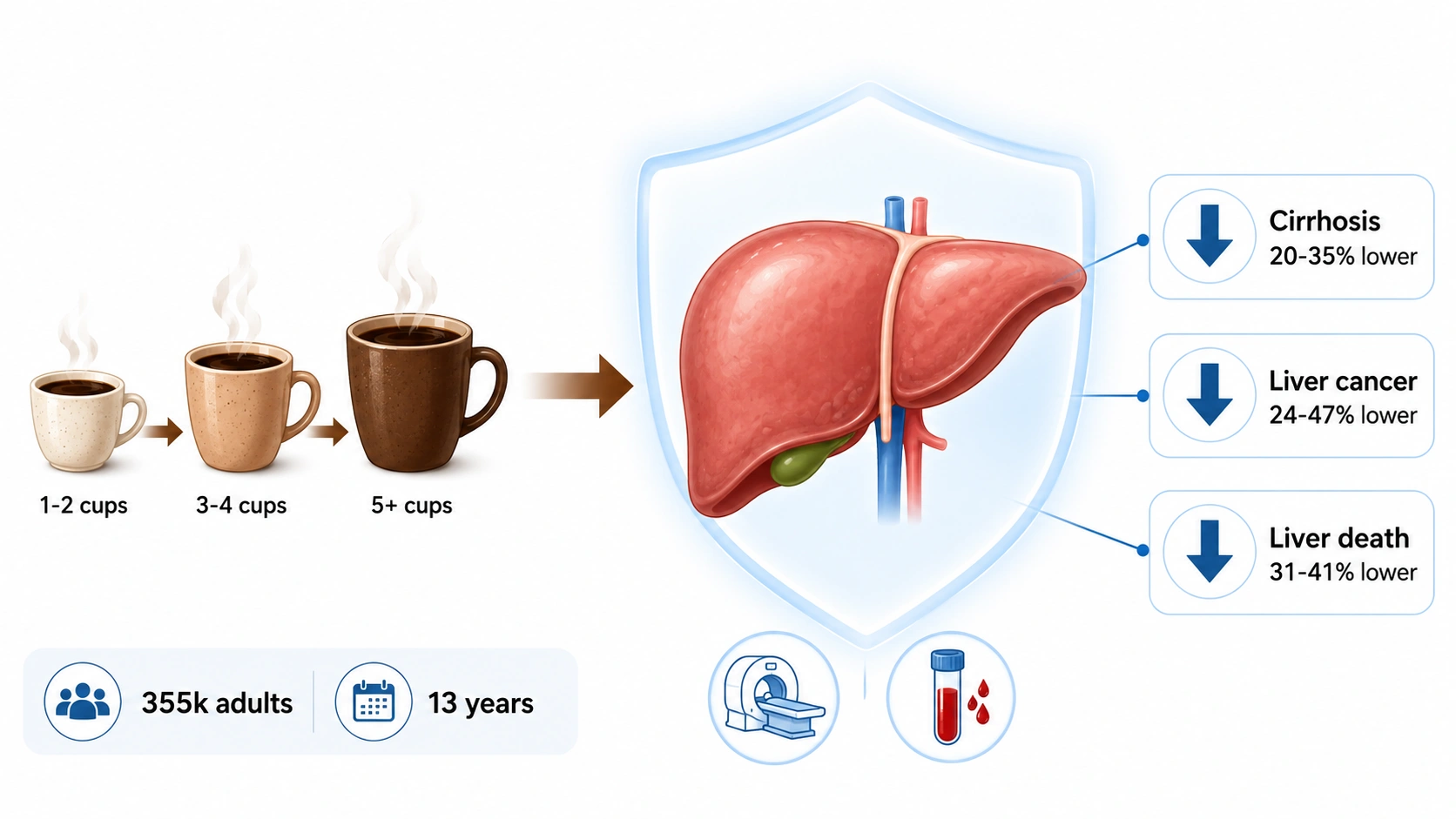
Coffee has spent the last few decades on trial in the court of public health, alternately accused and acquitted depending on which decade’s study you happened to read. The latest verdict, from one of the largest and most carefully constructed investigations yet, leans firmly toward acquittal, and then some. Researchers at Cedars-Sinai followed 354,957 adults from the UK Biobank, none of whom had cirrhosis or liver cancer to start, for a median of 13 years, and found that the more coffee people drank, the less likely they were to develop either.
The numbers move in a clear, ascending pattern. People who drank one to two cups a day had a 20% lower risk of cirrhosis, a 24% lower risk of liver cancer, and a 31% lower risk of dying from liver disease, compared with people who drank none. At three to four cups, those figures climbed to 35% lower cirrhosis risk and 35% lower liver cancer risk, with a 41% reduction in liver-related death. Five or more cups a day brought liver cancer protection up further still, to 47%, though cirrhosis protection settled slightly lower, at 32%, a nuance ScienceDaily noted rather than smoothing over into a tidy straight line. More coffee, in other words, generally meant more protection, but not in a perfectly obedient, textbook curve.
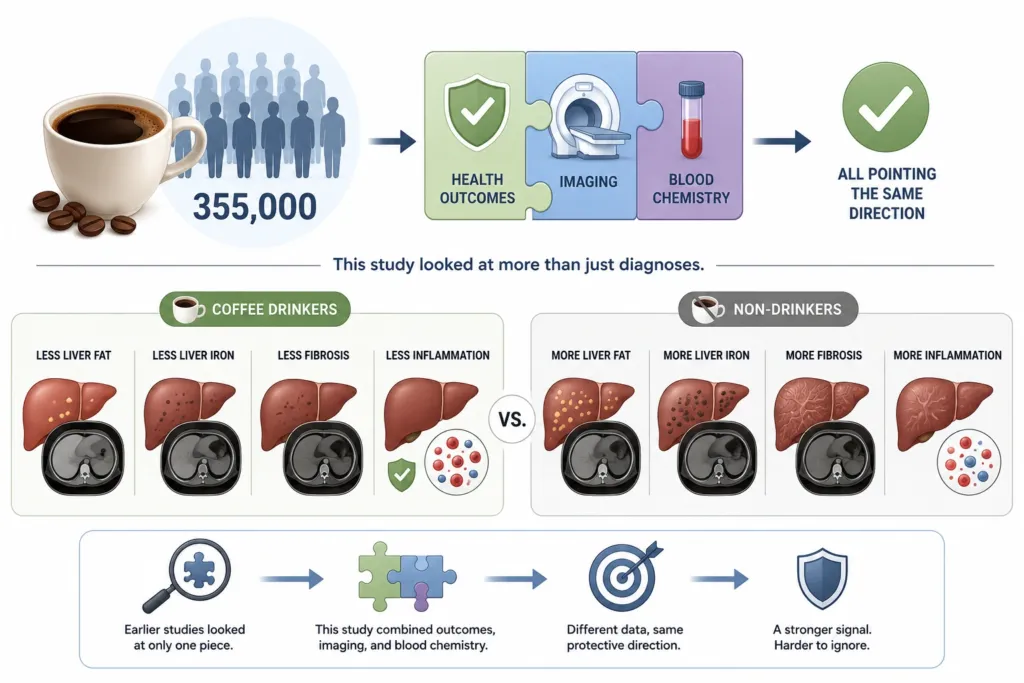
What sets this study apart from decades of earlier coffee research isn’t just its size, though 355,000 people is genuinely enormous for this kind of work. It’s that the researchers didn’t stop at counting diagnoses. They pulled liver MRI scans and blood protein analyses from a large subset of participants and found coffee drinkers carried measurably less liver fat, less liver iron, less fibrosis, and less inflammation than non-drinkers, changes visible well before any diagnosis would ever appear on a chart. Hyunseok Kim, the study’s corresponding author and a hepatologist at Cedars-Sinai, pointed out that most earlier research had only looked at one piece of the puzzle. This one had health outcomes, imaging, and blood chemistry all pointing the same direction at once, which is a considerably harder pattern to wave away as coincidence.
None of this means coffee is quietly curing liver disease, and the researchers were careful to say so themselves. Ju Dong Yang, the study’s senior author and medical director of Cedars-Sinai’s Liver Cancer Program, put it plainly: the findings support moderate coffee consumption for people who already enjoy and tolerate it well, not a prescription for people who don’t already drink it. An outside dietitian, Lauren Manaker, who wasn’t involved in the research, told CNN the numbers were genuinely meaningful for something as ordinary as a daily habit, while cautioning, correctly, that association still isn’t proof of cause.
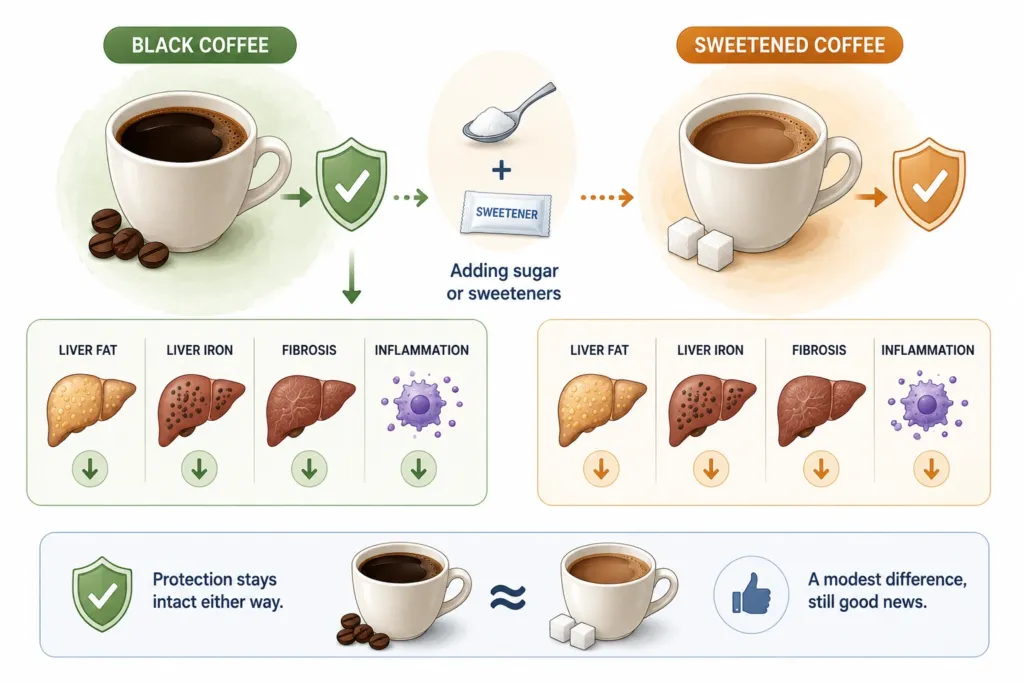
There’s a small practical wrinkle worth mentioning too. Adding sugar or sweeteners to coffee slightly reduced the protective association, though it stayed intact either way, which is at least modestly reassuring for anyone unwilling to drink it black.
The stakes behind all this are larger than they might first appear. Cirrhosis affects more than 58 million people worldwide and contributes to nearly 1.5 million deaths a year. Hepatocellular carcinoma, the liver cancer tracked in this study, is the fifth leading cause of cancer death globally and the second leading cause among men, after lung cancer, and it develops in roughly 85% of people who already have cirrhosis. Against numbers that large, a daily habit already built into most people’s routines, one that doesn’t require a prescription, a supplement aisle, or a dietary overhaul, is a rare kind of finding: genuinely good news that asks nothing new of anyone, beyond permission to keep doing what they were probably already doing anyway. For a family managing an older relative’s health, this sits comfortably alongside the broader case for prevention built from small, ordinary daily choices, and it echoes something researchers keep rediscovering across very different diseases: where a nutrient originates, and how consistently it’s part of daily life, tends to matter more than any single dramatic intervention ever could.